
Repair or replace: how often a water heater needs replacement
Two questions settle almost every repair-or-replace case: how old is the unit, and what does the fix cost? Answer both and the verdict usually writes itself. Below you will find the planning lifespans by heater type, the symptoms that separate a fixable fault from a finished tank, the 50% rule with 2026 national repair and replacement figures plugged in, and the line where do-it-yourself checking has to stop. Budget a few minutes.
Two situations skip this page entirely. A rotten-egg odor around a gas-fired heater is not a repair-or-replace question. Get everyone out of the house, then dial 911 and the gas company's emergency line from outdoors. On the way out, touch no switches, strike no flames, and save the phone call until you are clear of the building. Second: a tank that is wet on its own body rather than at a fitting or valve. Close the cold-water shutoff above the heater and stop deliberating: a tank rusted through from the inside cannot be patched, so the verdict is already in.
How often a water heater needs replacement, by type
Less often than sales pitches imply, more often than owners hope. The honest planning numbers:
| Type | Planning lifespan | What stretches it |
|---|---|---|
| Storage tank (gas or electric) | 8-12 years (the industry planning figure Angi and manufacturers use); DOE Energy Saver credits a well-maintained tank with 10-15 | Anode rod swap every 3-5 years; periodic sediment flush |
| Tankless | About 20 years, per DOE Energy Saver | Descaling on schedule, especially in hard-water areas; nearly every part is replaceable |
| Heat pump (hybrid) | 10-15 years (industry planning figure) | Filter cleaning, condensate drain maintenance |
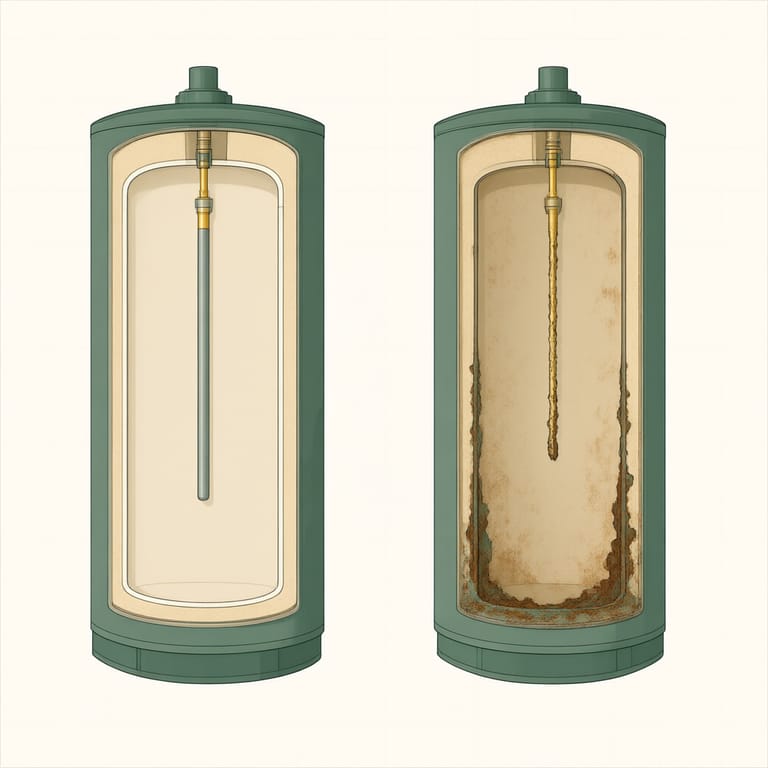
The spread inside "8-12" is not luck. What decides where a tank lands is mostly the anode rod, a bar of softer metal whose whole job is to rust away first so the steel shell does not. Put a fresh anode in every few years and the tank routinely lasts to the top of the range; leave the original in until it is gone and the tank checks out early. So "how often do you replace a water heater" has a two-part answer: roughly once a decade for tanks, and materially less often if you spend $150-$350 on a professional anode swap mid-life (HomeGuide's 2026 range for the job).
How to know when a hot water heater needs replacement
Start with what the heater is doing. Five symptoms cover nearly every case:
1. Water on the floor, but from where? This is the fork that matters most. Trace the moisture upward. If the trail ends at a threaded connection, the drain spigot, or the relief valve's outlet, that is a part, and parts get fixed, usually for modest money. If it ends at a seam in the tank shell, or the jacket itself is damp, the glass lining has given out, and the only fix is replacement. No exceptions worth your money. The leaking water heater guide walks through the leak-source test step by step.
2. No hot water, or not enough. An electric heater that has gone cold usually has a burned-out element or a failed thermostat; a gas model more often has a dead thermocouple or a gas control valve that has quit. All of it is routine bench work: a thermocouple part costs $20-$30, and element or thermostat work runs $100-$350 (HomeGuide, 2026). Age decides the verdict. At year five, fix it without a second thought; at year eleven, keep reading. The repair hub matches each symptom to the exact part.
3. Rusty or brown hot water. Discoloration only on the hot side, with the cold side running clear, is coming from inside the tank: either the lining or a used-up anode. Caught early, an anode swap can arrest it; rust plus metallic-smelling water on an old tank means corrosion is winning and the countdown has started.
4. Rumbling, popping, kettle noises. That is mineral sludge on the floor of the tank, with pockets of water beneath it turning to steam each time the burner or element fires. A flush quiets things if the layer is still young; scale baked on over years never fully drains out and quietly eats both efficiency and capacity. The noise guide sorts the sounds by cause.
5. The bill is creeping up. Heating water eats up roughly 18% of the energy a typical US home uses, by the EIA Residential Energy Consumption Survey's count, so a tank bleeding efficiency to sediment and tired parts leaves a mark on the bill. Worth a service visit rather than instant replacement, unless it arrives alongside symptoms 3 or 4 on a tank past year ten.
Rust, metallic-smelling hot water, or sediment noise that a flush cannot clear on a tank past year ten, and a tank-body leak at any age, mean it is time for water heater replacement rather than another repair. The hot water you still have is borrowed. Everything else, including most no-hot-water faults and a creeping bill, gets the math below.
The 50% rule, with real 2026 numbers
The lifespan table answers how often a water heater needs replacement on average. The 50% rule answers whether yours is due now. The trade's shorthand: once a single repair reaches half of what a new unit costs installed, the money belongs in the new unit, and age tips the scale before you even get there. Plug in the national figures. Water heater repair runs $228-$1,017, averaging about $600 (Angi, 2026); replacing a standard tank runs $881-$1,826 installed, averaging about $1,346 (Angi, 2026; see the full cost breakdown). So a $650 gas-valve repair on a nine-year-old tank is not "cheaper than replacing". It is half the price of a new unit, spent on a machine with a year or three left.
Embercrest's version of the test, as a table:
| Repair quote | Unit under 6 years | 6-9 years | 10+ years |
|---|---|---|---|
| Under about $300 | Repair | Repair | Repair only if minor, and start pricing replacements |
| About $300-$650 | Repair (check the warranty first) | Run the 50% math on your actual quotes | Replace |
| Over about $650 | Warranty-claim territory; the tank may still be covered | Usually replace | Replace |
This grid is our own framework built on the sourced ranges above; treat the boundaries as guidance, not gospel. Two adjustments worth making: warranty coverage moves everything toward repair (parts are often covered even when labor is not), and a tank that already shows rust or seam moisture moves everything toward replace, whatever its age.
Ready to talk to a licensed water heater pro?
Call (800) 555-0184Free call. A licensed local water heater installer picks up.Licensed water heater partners in your area- Licensed and insured partner network
- 24/7 call routing
- Free call, no obligation
- You approve the price with the installer directly
What each outcome costs
So you can calibrate urgency, here are the 2026 national ranges for the likely outcomes of the decision tree (HomeGuide for parts and labor on repairs, Angi for complete replacements):
| Outcome | Typical 2026 cost |
|---|---|
| Anode rod replaced by a pro | $150-$350 (the part alone is $20-$50) |
| Heating element | $100-$350 |
| Thermostat | $100-$350 |
| Thermocouple | $20-$30 for the part, plus the service call |
| Gas control valve or a complex leak repair | $200-$750 |
| Storage tank replacement, installed | $881-$1,826 (average about $1,346) |
| Tankless replacement, installed | $1,400-$3,900 typical project; complete replacements commonly $2,500-$4,500, with tank-to-tankless conversions at the top of that range |
| Heat pump (hybrid) replacement, installed | $3,200-$4,700 typical |
Part-by-part pricing with the labor assumptions spelled out is in the repair cost guide. On the replacement side, labor, permits, and code extras (expansion tank, relief-valve discharge piping, venting changes) are what move a quote from the bottom of its range to the top.
What you can check yourself, and where DIY stops
Fair game without a pro: decoding the manufacture date from the serial number on the rating plate (the decision tree's most useful input), confirming the breaker has not tripped on an electric model, one attempt at relighting a gas pilot by the instructions printed on the unit (none at all if there is any gas smell), and a hands-off visual hunt for the leak source. Draining a few quarts to see how much sediment rides along is fine if the valve cooperates, but assume what comes out will scald: with the dial at 140F, the CPSC exposure tables say skin reaches a third-degree burn in roughly six seconds.
Hand it to a licensed pro, no exceptions: the 240-volt wiring on an electric heater, any gas component past that one pilot relight, the flue and venting (a loose or mis-sloped connection can dump carbon monoxide into the living space), and the temperature-and-pressure relief valve, a safety device that was never meant to be a tinkering opportunity. Water heaters combine pressure, scald-temperature water, and combustion or high voltage in one appliance; the repair bill for humility is always smaller.
Do not wait for the emergency premium
Knowing how often a water heater needs replacement only pays off if you act before the tank does. Replace on your own schedule and you get to gather quotes, choose the model, and book a weekday-hours install. Wait for the tank to fail and you pay whatever same-day availability costs, take whichever unit is on the truck, and quite possibly mop up a flooded utility room besides. If your tank is past year ten and the 50% math against current replacement prices is already leaning replace, acting a season early is the cheap version of this decision.
One forward-looking note for electric-tank owners: DOE efficiency standards taking effect May 6, 2029 mean new electric storage heaters larger than 35 gallons will have to be heat pump models. Nothing forces you to replace early. But if your electric tank is on borrowed time anyway, know that the like-for-like option gets phased out, and factor that into whether you buy the last conventional generation or step up to a heat pump unit now.
Call today, not this quarter, if...
- The tank body is leaking or weeping. Replacement is now a scheduling question, not a decision.
- Hot water smells metallic and runs brown on a 10-year-old unit.
- The relief valve keeps discharging, or you hear sustained boiling sounds. Overpressure and heavy sediment are not wait-and-see problems.
- You have paid for two repairs inside a year on a tank past mid-life.
A licensed installer can confirm the diagnosis, give you the real numbers for both paths, and, if it comes to it, do the replacement the same visit. Call (800) 555-0184: the call is free, it connects you with a licensed local water heater installer any day of the week, and every dollar of work gets approved by you, directly with the pro.
Ready to talk to a licensed water heater pro?
Call (800) 555-0184Free call. A licensed local water heater installer picks up.Licensed water heater partners in your area- Licensed and insured partner network
- 24/7 call routing
- Free call, no obligation
- You approve the price with the installer directly