
Shower ran cold, the floor around the tank is wet, or the utility room smells faintly of gas? Wet floor: kill the heater's power (flip its breaker on an electric unit, turn the gas control to OFF on a gas one), then shut the cold inlet valve above the tank so it stops refilling. Gas odor (rotten eggs): get everyone out right away, touch no light switches, strike no flame, make no calls until you are outside, then phone 911 and the gas utility from the street. With everyone safe, work through the no-hot-water checks or call (800) 555-0184; that one call reaches a licensed local installer who takes emergency replacement and repair of water heaters.
The rest of this site is for the slower version of that moment: an old tank, a lukewarm shower, a quote on the counter.
Three questions decide the whole project
Fix it or swap it out? A heater that fails in its fourth year gets repaired; the identical failure in year eleven usually means a new unit. The repair or replace guide converts that gut feeling into a test: unit age weighed against the repair invoice.
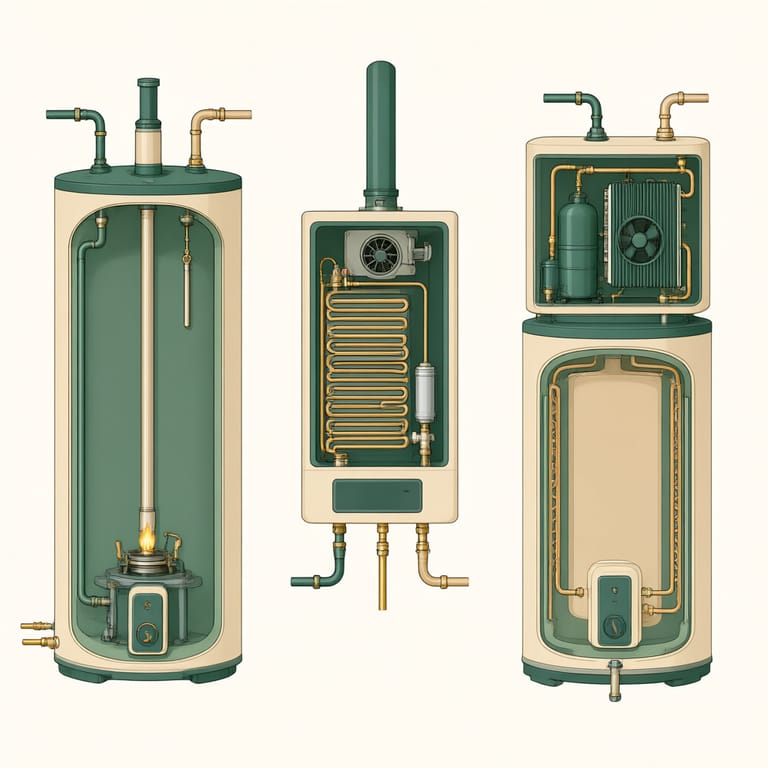
Which design goes in next: a storage tank, a tankless unit, or a hybrid heat pump? Each wins one column: the tank on purchase price, tankless on service life and floor space, the heat pump on running cost. The tankless hub walks through the trade-offs, and the tankless vs tank comparison lines the two up head to head.
And what is a fair bill? Not a single national average, but the lane for your fuel, tank size, and situation, with every add-on named up front. Begin with the cost guides.
Water heater replacement in 2026: the baseline numbers
Heating water eats roughly 18% of the energy a typical U.S. home consumes, per the U.S. Energy Information Administration, and the Department of Energy ranks it the second-biggest energy bill in most American homes. EIA's household survey also splits the fuel almost down the middle, about 48% natural gas against 46% electric, so the gas-or-electric question surfaces in nearly every replacement.
The 2026 national picture Embercrest builds its pages around:
| Option | Typical installed cost (2026) | Planning lifespan | The catch |
|---|---|---|---|
| Storage tank (gas or electric) | $881-$1,826, average about $1,346 (Angi) | 8-12 years (industry planning figure) | Lowest purchase price, shortest life, loses heat while idle |
| Tankless | $1,400-$3,900 typical; complete replacements commonly $2,500-$4,500 (Angi) | About 20 years (DOE) | Converting (gas line, new venting) can cost as much as the unit |
| Heat pump (hybrid) | $3,200-$4,700, average about $4,200 (Angi) | 10-15 years (industry planning figure) | Priciest to buy, cheapest to run; wants room around it and a drain |
| Repair instead | $228-$1,017, average about $600 (Angi) | Not applicable | Makes sense only on a heater young enough to earn it back |
A bid well outside those lanes earns a question rather than outrage. Often the difference is real code work: an expansion tank the inspector expects, a proper discharge pipe off the relief valve, venting brought up to current rules, or earthquake straps where the state requires them. The labor cost breakdown sorts the routine line items from the ones that justify a second bid.
Hot water heater replacement choices, from storage tank to tankless to heat pump hybrid
Plenty of homeowners still say hot water heater, and the replacement options number three: a storage tank, a tankless unit, or a heat pump hybrid. Most swap like for like; a same-fuel, same-capacity swap remains the quickest and least expensive route. Two facts deserve a look first. By the Department of Energy's figures, a household drawing roughly 41 gallons of hot water a day or less gets 24-34% better energy efficiency from a tankless unit than from a storage tank, with a service life near 20 years. Separately, DOE efficiency rules taking effect May 6, 2029 will push new electric storage heaters above 35 gallons onto heat pump technology, making a plain electric resistance tank bought now the last of its generation. Neither fact crowns tankless or heat pump the automatic answer: a replacement gas water heater in a house with sound venting and a modest draw is often the sensible buy, and the electric replacement page works the resistance-versus-heat-pump arithmetic for the electric half of the country.
When the old tank is a 50 gallon. A label that reads 50 gallons puts a like-for-like swap squarely in the usual $881-$1,826 lane; capacity is the lever that slides a job across Angi's wider $600-$2,500 spread. A 50 gallon electric hot water heater also falls under the 2029 rule above, so the 50 gallon electric cost guide prices both paths.
Can a water heater be swapped without calling a plumber?
On a gas unit, consider the question closed: no. The gas hookup, the combustion vent, and the discharge pipe off the temperature-and-pressure relief valve are the three places a sloppy install becomes a carbon monoxide or scalding problem, and plenty of building departments want a permit pulled for the swap whatever the fuel (see permits for water heater work). An electric-for-electric swap edges toward DIY territory, and the DIY replacement guide is candid about where that territory ends: the permit usually applies anyway, and 240-volt wiring belongs to a licensed pro. A licensed installer's replacement service bills largely for that: trained hands, permit paperwork, haul-away, and the code items that keep the new tank uneventful for twelve years.
Ready to talk to a licensed water heater pro?
Call (800) 555-0184Free call. A licensed local water heater installer picks up.Licensed water heater partners in your area- Licensed and insured partner network
- 24/7 call routing
- Free call, no obligation
- You approve the price with the installer directly
Ready to replace it? What one call does
Type water heater replacement near me into a search box and you get a wall of ads; adding the word best merely shuffles them. The number on this site bypasses the shuffle: one free call puts you through to a licensed, insured installer partner near you, any hour, weekends included. You describe the heater (fuel, capacity, age, what it is doing), the installer prices the job, and Embercrest neither sets nor marks up that price. Ask at the outset whether the estimate is free and firm; a same-fuel, same-size swap is often quoted from the description alone. Same-day replacement of a like-for-like tank is routine when the unit is in stock; a conversion to tankless or heat pump generally needs a second visit. In an emergency (a leaking tank, a cold heater in January), call first and read later.
Cheap, affordable, or best: what a fair water heater replacement price looks like
Cheap, defined honestly, means a storage heater traded for one of the same fuel and capacity at the bottom of the $881-$1,826 lane, with no venting or wiring changes. What turns the cheapest replacement bid into the expensive one is what it omits: the permit, the expansion tank, the discharge line off the relief valve, the haul-away. Those are code requirements, not upsells; a quote missing them is incomplete, not affordable. Hand every installer the same itemized checklist (unit, labor, permit, code parts, disposal) and compare totals.
Affordable is a service-life question. With heating water near 18% of a home's energy use (EIA), the heater cheapest to buy can be the most expensive to own: the heat pump pairs the steepest price in the table above with the lowest running cost, and a tankless unit pays back its premium in a household using about 41 gallons of hot water a day or less (DOE).
The best replacement water heater is a fit, not a ranking: the fuel already piped to the spot, a capacity sized to how much hot water the house draws at once, venting and relief piping an inspector will sign off on, and a licensed, insured installer who pulls the permit. Two or three bids assembled on that checklist beat any search for cheapest or best.
What Embercrest is, and what it is not
Embercrest is an independent publisher, not a plumbing or HVAC contractor. Its pages draw on federal energy data (EIA, the Department of Energy, ENERGY STAR), safety guidance from the CPSC and OSHA, and national repair and installation cost databases (Angi, HomeGuide), and every number names its source. Drafts are written with AI assistance, then checked against those sources before anything goes live; the editorial policy lays out the process and the About page names who stands behind it. The phone number here reaches licensed, insured local installation partners, and Embercrest may be paid for qualified referrals; how we make money spells that out, and it never changes the price you pay. Coverage is national: figures are U.S. averages and ranges, with pages flagging where your state, utility, or climate moves the math.
When you are done researching
Call (800) 555-0184. The call costs nothing, and you approve any work and price directly with the installer. Want to keep reading instead? The repair hub ties water heater symptoms to the part that is failing, and the cost guides itemize the quote you are about to receive.
Ready to talk to a licensed water heater pro?
Call (800) 555-0184Free call. A licensed local water heater installer picks up.Licensed water heater partners in your area- Licensed and insured partner network
- 24/7 call routing
- Free call, no obligation
- You approve the price with the installer directly