
Heat Pump Water Heater Replacement: The Fit Test, the Cost, and Install Day
A heat pump water heater replacement buys three to four times the efficiency of a standard electric tank, provided your space, wiring, and expectations check out. Regulators have already made the long-run choice: under DOE standards that take effect May 6, 2029, new electric storage water heaters over 35 gallons must use heat pump technology. So the 2026 question is whether your utility room, circuit, and household schedule fit one, and whether the premium pencils out.
Tank leaking as you read this? Kill the breaker before touching it (a live electric heater standing in water can shock you), or turn a gas model's dial to OFF; then shut the cold-water valve on the inlet and crack a hot faucet open to relieve pressure. A puddle at the base means the inner shell has split; no part brings it back.
Already without hot water? Call (800) 555-0184. The number rings through to a licensed, insured installer near you from Embercrest's partner network who works on heat pump models; the call costs nothing, and you settle the price with that installer.
Who ends up swapping a tank for a heat pump unit
- An electric tank past year 10. The industry planning life for a storage tank is 8-12 years (Angi, 2026); owners in that window want the next purchase to be the efficient one.
- An electric bill that will not come down. Heating water takes roughly 18% of a household's energy (EIA, RECS 2020), and close to 46% of US homes do it with electricity (EIA), mostly through resistance tanks, the least efficient common option.
- A gas tank and a wish to get off gas. Doable, provided the new 240-volt circuit is in the first quote. The licensed pro caps the gas supply, seals the old vent, and checks any flue the water heater shared with a furnace, which must keep drafting once its neighbor is gone (carbon monoxide is the risk). Smell gas at any point? Get everyone out first, then phone 911 and the gas company from the yard; inside, touch no switch, strike no flame, make no calls. The fuel math lives in the gas vs electric guide.
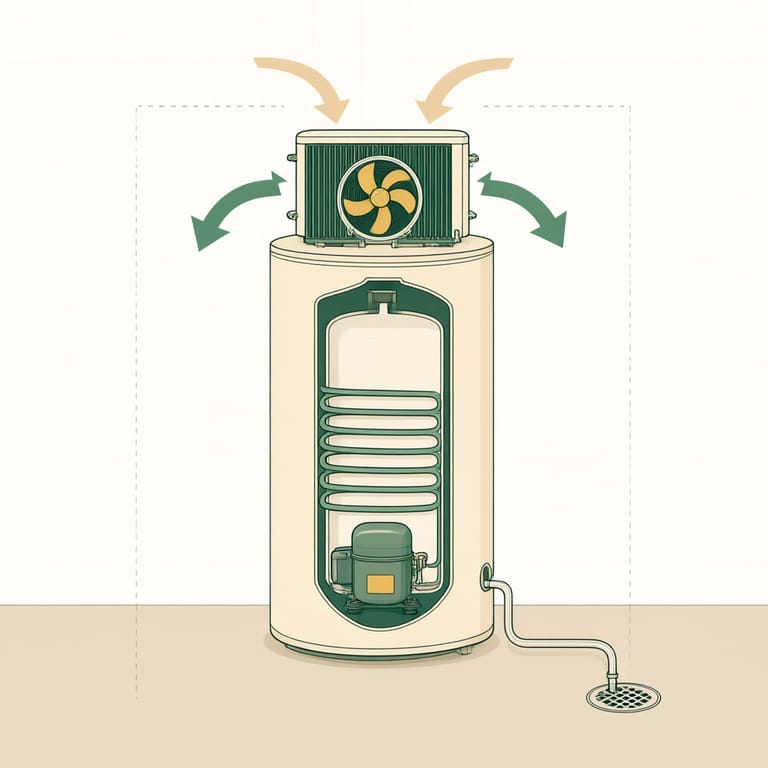
Will one fit your house? The four-point fit test
- Power. A 240-volt circuit is non-negotiable. An existing electric tank's circuit usually serves; leaving gas behind means adding one, and new circuits, breakers, or panel capacity are licensed-pro territory.
- Air. The compressor strips warmth from the air around the tank, so every spec sheet lists a minimum room size, or calls for a louvered door or duct kit in a closet. Basements, garages, and roomy utility rooms pass; a closed closet needs a workaround, priced in the bid.
- Height and clearance. With the heat pump module on top, the unit stands taller than the tank it replaces. A low crawl-space ceiling is the classic deal-breaker; measure before any equipment is ordered.
- Somewhere for condensate to go. Chilling room air wrings moisture out of it, the way a window AC drips. That water needs a gravity line to a floor drain or a small pump to lift it there.
Why the efficiency claim is real
A resistance element creates heat from scratch; a heat pump relocates heat already in the room, and moving is cheaper than making. Current ENERGY STAR certified units are typically rated 3.3-4.1 UEF versus roughly 0.9-0.95 for a standard electric tank: three to four times the hot water per kilowatt-hour, worth about $550 a year for a family of four by ENERGY STAR's estimate. At the US average residential price of 18.44 cents per kWh (EIA, May 2026), every kilowatt-hour the heat pump saves shows up on the bill.
One 2026 caveat: the federal 25C tax credit that once covered 30% of these projects no longer applies to units put into service after December 31, 2025 (IRS). Any 2026 pitch built on "the government pays $2,000 of this" is an old script. State programs and utility rebates survive in many areas; have the installer name the exact program, then check it.
What install day looks like
When the fit test passes, a competent installer treats this as a same-day job:
- Site check against the quote: circuit, clearances, condensate route, drain pan. Anything off gets flagged before a tool comes out.
- Drain and pull the old tank. Haul-away belongs on the invoice.
- Set and connect the new unit: water, power, condensate, plus a drain pan wherever code or the location calls for one. Expect a permit line item; most places treat a water heater swap as permitted work, which helps you at resale (see the permits guide).
- Commission and configure. The installer picks the mode (heat-pump-only for maximum savings; hybrid for faster recovery) and dials in the setpoint. The CPSC's scald guidance is 120F, since 140F water can inflict a third-degree burn in roughly six seconds; OSHA points out that 120F storage leaves Legionella alive, so some households with vulnerable members keep the tank hotter behind a mixing valve. Settle it with the installer, and get the air-filter schedule in writing.
You sign off twice: on the quote before any wrench turns, and on the result after: hot water at the taps, dry fittings, condensate moving, a T&P discharge line ending in the open where you can see it, never capped (ICC guidance).
What heat pump water heater replacement costs in 2026
| Option | Typical installed price | Average |
|---|---|---|
| Standard electric tank swap | $881-$1,826 | About $1,346 |
| Heat pump (hybrid) unit | $3,200-$4,700 (observed range $2,800-$8,000) | About $4,200 |
Source: Angi, 2026 national installation data. What pushes a heat pump bid across its range:
- Wiring: coming off gas means a fresh 240V circuit, and sometimes more panel capacity first
- Condensate route: a short gravity line costs little; a pump or a long run costs more
- Room changes: a louvered door, duct kit, platform, or pan work
- Size and efficiency tier: larger tanks and higher-UEF models cost more up front and return more monthly
Set beside the roughly $1,346 average for a plain tank swap, the gap is about $2,900; at ENERGY STAR's roughly $550 a year for a four-person household, it closes in five to six years. A smaller home takes longer, so run the math on your own bills; the cost center holds the rest of the national figures.
Ready to talk to a licensed water heater pro?
Call (800) 555-0184Free call. A licensed local water heater installer picks up.Licensed water heater partners in your area- Licensed and insured partner network
- 24/7 call routing
- Free call, no obligation
- You approve the price with the installer directly
Replace now, or ride the old tank out?
The planning life of an electric tank is 8-12 years. Inside that window with no symptoms, keep running it; a working heater owes you nothing. Replace ahead of failure when the tank is past year 10, when an element or thermostat repair is quoted near half of a new tank (the 50% rule this site applies everywhere), or when moisture shows at the base. Retire it on your own timetable and you get a planned quote; let it fail wet and you get an emergency one. For a like-for-like swap, see the electric tank replacement page or the general water heater replacement guide.
Three hesitations, answered honestly
"It costs about three times a standard tank." True at the averages, and the federal credit no longer softens it. The savings are just as real; what decides it is how long you will be paying the electric bill. Moving within a few years? A plain electric tank is the easier number to defend.
"I do not want my utility room torn up for days." Pass the fit test and nothing gets torn up: old tank drained and carried out, new unit set, plumbed, and wired; hot water is back the same day, usually within hours.
"Could I install it myself?" The unit is tall and heavy, the 240-volt hookup is licensed-pro work, the T&P discharge and condensate lines carry code rules, and the job usually needs a permit inspectors and insurers will ask to see. Read the DIY water heater page before deciding.
The drawbacks nobody puts in the brochure
- It is not silent. A compressor and fan run, about as loud as a window air conditioner on low. Fine in a basement or garage; a closet sharing a wall with a bedroom is another story.
- It chills its own room. The warmth it pulls from the air has to come from somewhere: welcome beside the furnace in July, a genuine cost in a small heated space in January.
- Heat-pump-only mode reheats slowly. Hybrid mode covers back-to-back showers by switching the resistance elements in, at resistance-level rates for those minutes.
Heat pump questions that come up before the quote
Can it replace a gas water heater? Yes. Budget for a new 240V circuit and a licensed pro to cap the gas line, and make sure both appear in the first quote.
What size do I need? No smaller than the tank you have. Heat-pump-only mode reheats more slowly, so if your tank already runs dry at peak hour, ask about one size up or plan on hybrid mode.
How long do they last? Figure on 10-15 years (industry estimate), in line with a quality tank; the compressor is the one extra part that wears.
What maintenance does it need? Wash or swap the air filter on the maker's schedule, keep the condensate line from clogging, and keep up normal tank care (periodic flush, anode rod check).
Do I need a permit? Almost everywhere, yes, and you want one: unpermitted work tends to resurface at inspection, at sale, or in an insurance claim.
When to make the call
Signs that move this from "someday" to "this week": water or rust streaks at the foot of the tank; the heater's breaker tripping a second time; a repair quote near half a new tank's price on a unit past year 10.
If your home heats water with electricity and the space clears the four-point test, a heat pump water heater replacement is one of the few upgrades where the efficiency math actually closes. Call (800) 555-0184 to reach a licensed, insured installer near you who quotes your exact setup, circuit, condensate, clearances, and permit in writing; the go-ahead is yours, and you pay the installer, not this site.