
Hiring a Plumber for Water Heater Replacement: 2026 Costs and Process
Here is the number up front, before any sales visit: a straight tank-for-tank swap runs $881 to $1,826 installed for most US homes, with the national average near $1,346 (Angi's 2026 data; the full spread reaches $600 to $2,500 depending on tank size). If you are searching for a plumber for water heater replacement, that range is your reference point, and everything an installer adds beyond the unit itself (code corrections, venting, the permit) should appear as a line item you can question. Need someone today? Call (800) 555-0184 and Embercrest connects you with a licensed, insured local installer; the call is free and you approve every price directly with the pro.
Signs you are shopping for a new tank, not a part
- Water under the tank that traces to the shell, not a fitting. A drip at a valve, fitting, or element port is a part; weeping from the steel body or a seam means rust has gone through the lining, and no part fixes that.
- Rusty hot water while the cold taps run clear. The sacrificial anode has been used up, so oxidation has moved on to the steel liner; the color you see is the tank slowly dissolving.
- Past 10 years, with a second repair call pending. Industry planning figures (Angi) give a storage tank 8-12 years of service. Spending $600 on a 10-year-old unit buys you a repaired old unit.
- Rumbling, popping, and a shrinking supply. Sediment has insulated the bottom of the tank; a flush helps a younger unit and often just reveals a weep on an old one.
Repair money or replacement money?
Across the US, a water heater repair bill lands between $228 and $1,017, with the average near $600 (Angi 2026). Two facts decide which budget you are in: where the water is coming from, and how old the unit is. A useful shorthand: when the repair quote passes half of the replacement cost on a tank past mid-life, replacement usually wins the math. Borderline cases: work through the repair-or-replace guide.
Gas hot water heater repair before you buy a new tank
One rule before any of this: a gas smell means everyone walks out of the house right away, and the calls to 911 and the gas utility happen from outside. On the way out, touch no light switch, strike no flame, and leave the phone alone until you are clear of the building. Gas piping, venting, and combustion air are licensed trades nearly everywhere in the US; the list below is what a pro fixes, not weekend work.
When a gas unit keeps dropping its flame or heats weakly, the fault usually sits in a part rather than the tank. The usual suspects, priced with 2026 national repair ranges from HomeGuide and Angi:
- Thermocouple or flame sensor. The part runs $20-30; the giveaway is a pilot flame that dies again minutes after you relight it.
- Gas control valve replacement, or a leak that is hard to get at. $200-750, with the complicated jobs filling the top of that band.
- Sediment, burner, or draft problems. A flush or a burner cleaning lands in the $100-350 small-fix band.
The repair hub sorts symptoms by part; once the shell weeps, repair loses.
Electric hot water heater repair: the short list of fixable parts
An electric tank offers fewer things to break: heating elements and their thermostats, each a $100-350 repair in HomeGuide's 2026 per-part data. A high-limit reset that needs pressing again and again points at an element or thermostat on its way out. Anything on the 240-volt side belongs to a licensed pro: breaker off, then a meter proving the circuit dead before any terminal is touched. If the elements test fine and the shell still leaks, you are back to replacement.
What each replacement path costs, and how long it lives
Heating water claims roughly 18% of a US home's energy use (US Energy Information Administration), so whichever path you choose here, you keep paying for that choice on every bill for a decade.
| Replacement path | Installed cost (2026 national) | Typical service life |
|---|---|---|
| Storage tank (gas or electric) | $881-$1,826 typical; avg ~$1,346 | 8-12 years (industry planning figure) |
| Tankless (on-demand) | $1,400-$3,900 typical project; complete installs commonly $2,500-$4,500, conversions at the top | ~20 years (US DOE Energy Saver) |
| Heat pump (hybrid) tank | $3,200-$4,700 typical; avg ~$4,200 | 10-15 years |
Cost figures are Angi's 2026 national ranges; lifespans per DOE and industry data. The cost hub breaks each path down with the operating-cost math.
What a plumber for water heater replacement actually does
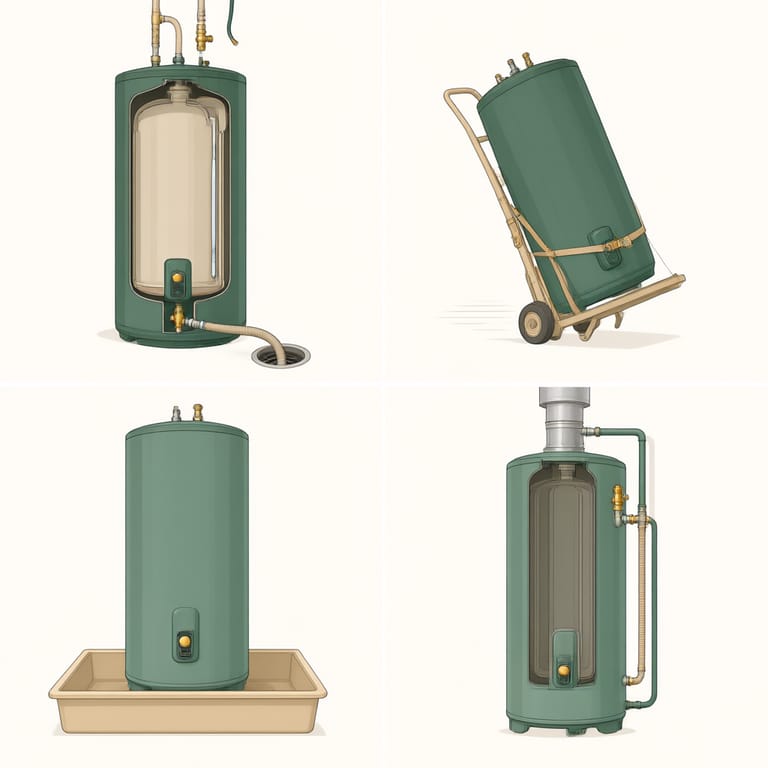
The store shelf shows the unit; the installer's visit is the rest of the job. On a matching-tank swap the sequence runs: supply water and fuel (or power) shut off, tank emptied through a garden hose, unions plus the vent connector or the wiring taken apart, old tank carried out empty, new unit set on its pan or stand, connectors made up, gas line checked for leaks or the 240-volt circuit landed again, venting refastened at the right slope and clearance, tank refilled, trapped air bled at a hot tap, burner or elements brought up.
Two checks close the job. The temperature-and-pressure relief valve gets tested and its discharge pipe confirmed: full size, air gap, never capped, because a plugged discharge has caused tank explosions (ICC guidance). The thermostat gets set: 120F is the CPSC's scald-safety setting. Households with immunocompromised members should ask about storing at 140F with a thermostatic mixing valve delivering 120F at the fixtures, since 120F storage does not kill Legionella (OSHA guidance); the valve is not optional, because about 6 seconds of contact with 140F water is enough for a third-degree burn (CPSC).
How the job runs from your side
- The phone call. Have three facts ready: fuel type, tank capacity, and where the unit lives (garage, basement, attic, closet). With those, a straight-dealing installer can quote a realistic range before visiting; you approve the price with the pro, not with Embercrest.
- The written quote. Unit, labor, code items, permit, haul-away: visible and separate.
- Replacement day and sign-off. Usually one visit, water off for part of the day, and the two checks above done before anyone leaves.
Ready to talk to a licensed water heater pro?
Call (800) 555-0184Free call. A licensed local water heater installer picks up.Licensed water heater partners in your area- Licensed and insured partner network
- 24/7 call routing
- Free call, no obligation
- You approve the price with the installer directly
Why the plumber's quote runs above the store price
The unit on the shelf is one line of what a plumber for water heater replacement will quote you; a defensible quote shows the rest, itemized:
- Labor and haul-away. Hauling the old tank out and away, then setting, connecting, and firing the new one.
- Code catch-up. Where the old install went in under an earlier code cycle, the quote will likely add an expansion tank, a relief-valve discharge pipe that meets today's rule, a drain pan where one is required, seismic straps in some states, or a venting correction. None of that is padding on the invoice; it is the list the inspector walks through at sign-off.
- The permit itself. In most jurisdictions a permit is due even when the new tank matches the old one. Details in the permit guide.
What moves the price beyond those items: tank size (a 75-gallon unit costs more to buy and to move), location (attic and tight-closet jobs take longer), fuel type (gas adds venting labor), after-hours scheduling, and any relocation of the unit. What should make you push back: line items nobody explains, "fuel surcharges" on a local job, or a quote that exists only as one round number.
Gas job or electric job? They are different animals
A gas replacement adds venting, combustion air, and fuel-connection work, the part of the job with the least DIY tolerance. An electric replacement trades those hazards for a 240-volt circuit and a different decision: whether a heat pump unit now makes sense, given the DOE efficiency standard due in May 2029, which pushes most new electric storage tanks above 35 gallons onto heat pump technology. Each has its own page: replacing a gas water heater and replacing an electric water heater.
Three worries before you book, answered honestly
- "Is the best repair pro near me the cheapest one, or the biggest name?" Neither, necessarily. For a water heater, "best" means three checkable things: a license that covers gas or electrical work in your state, an itemized quote you can hold against the national ranges above, and a straight answer on repair versus replacement once the hot water quits on a tank past mid-life. A cheap fix on a 10-year-old shell is the expensive choice (the 50% shorthand above).
- "Will this wreck my house for a week?" Not for a matching-tank swap: that job is one path through the hallway, an emptied tank on a dolly, and a few hours without hot water. Conversions and relocations are the messy ones, and the quote should flag them as such.
- "I could do this myself." Parts of it, maybe. The DIY replacement guide is honest about which halves a capable homeowner can handle and which (gas connections, venting, 240-volt wiring, the relief-valve discharge) put a licensed name on the line for a reason.
Emergency hot water heater repair and the 24-hour call
Partner installers on Embercrest's line answer 24/7, weekends included; the real question is whether your problem needs a 2 a.m. visit, because after-hours scheduling is one of the items that lifts a bill above the national ranges here.
Call now, any hour, if:
- Water is running from the tank shell or its seams rather than a fitting. If the cold-water inlet valve on top of the tank is within safe reach, close it first; the phone comes second.
- You smell gas near the unit: follow the protocol above, then call the utility before anyone else.
- Soot, scorch marks, or melted plastic at the draft hood or burner door (flame rollout or backdrafting, a carbon monoxide risk).
- The relief valve discharges repeatedly, or its discharge pipe is capped.
Usually fine for the first daytime slot: no hot water on a dry tank, a pilot that will not stay lit, a slow drip at a fitting you can catch in a bucket, or the second breakdown in a year on a unit past 10 years (that one is a replacement conversation, not a midnight repair).
If you are typing "emergency repair near me" with no hot water at midnight, the water heater itself is rarely the urgent part; water on the floor and any gas or combustion symptom are. Say "emergency" and the fuel type when you call, day or night; the after-hours rate is the installer's to quote and yours to approve before work starts, so ask for it up front.
A call to (800) 555-0184 reaches Embercrest's dispatch line, day or night, which connects you with a licensed, insured plumber for water heater replacement in your area, for a quote you can hold against every number on this page.
Ready to talk to a licensed water heater pro?
Call (800) 555-0184Free call. A licensed local water heater installer picks up.Licensed water heater partners in your area- Licensed and insured partner network
- 24/7 call routing
- Free call, no obligation
- You approve the price with the installer directly