
Tankless water heaters, fine print included
With a tankless water heater nothing sits in storage; the burner or element fires when a faucet opens, quits when it closes. That single choice explains everything people love about the category (no standby heat loss, no 50-gallon drum waiting to rust out, no cold shower because a teenager got there first) and everything they discover later: flow limits, pickier installs, and a price that climbs once the house needs work. The efficiency numbers are real and so is the 20-year lifespan; whether the switch pays off depends on how much hot water your household actually uses. Water heating is about 18% of household energy use per the U.S. Energy Information Administration (EIA), and the Department of Energy (DOE) ranks it the second-largest energy expense in most homes.
The numbers that hold up
Lifespan. DOE puts tankless life expectancy at roughly 20 years, versus the 8-12 years installers and Angi's 2026 cost data use as the planning figure for a tank. Nearly every part is replaceable, so one unit can outlive two tanks.
Efficiency, for the right house. DOE's same page puts the tankless gain at 24-34% over a storage tank, but only where daily hot water draw stays near 41 gallons or under. Near 86 gallons a day the edge narrows to 8-14%; a tank that rarely sits idle wastes little standby heat.
The rulebook. DOE's residential standards effective May 6, 2029 push electric storage units over 35 gallons to heat pump technology; gas tankless units sit outside that rule.
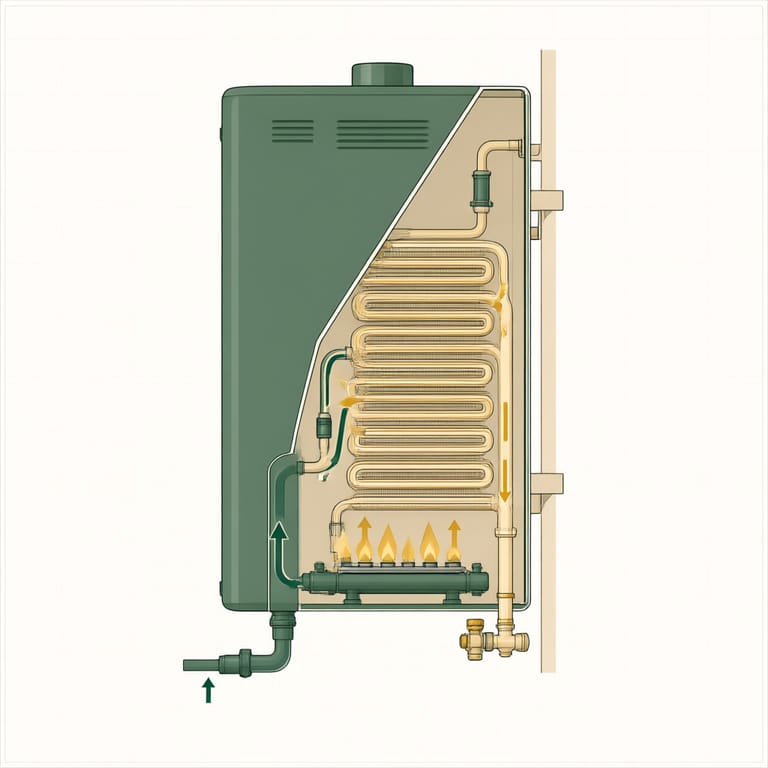
Where a tankless water heater falls short (the downsides)
- Cold slugs between hot bursts. Shut the hot tap, reopen it moments later, and a pocket of cold water rides between two hot runs (the cold-water sandwich); "endless" is not "seamless."
- Minimum flow to fire. A barely-open tap for a slow rinse may never reach the flow rate that triggers the burner.
- No power, no hot water, even on gas. Most gas units need electricity for ignition and controls; a standing-pilot gas tank works through a blackout, a gas on-demand unit usually does not.
- Scale is the killer. Hard water coats the heat exchanger; the unit throttles output and throws error codes rather than tolerating it. Descaling becomes a calendar item.
- The quote is the unit plus the house. Gas line upsizing, venting, condensate, sometimes panel work: covered below.
None of these is disqualifying.
Six households, six verdicts
| Your situation | Verdict | Why |
|---|---|---|
| 1-2 people, modest hot water use, gas in the house | Strong fit | Squarely in DOE's 24-34% savings zone; the space savings are free |
| Large family running showers, laundry, and dishwasher at once | Fit, if sized honestly | Flow rate is the constraint; undersize it and you will hate it |
| Tank just died, hot water needed tonight | Lean tank, decide later | A like-for-like swap is a same-day job; a conversion adds venting, gas, and possibly electrical scope |
| All-electric home, no gas line | Check your panel first | Whole-home electric units draw serious amperage; many homes do better with a heat pump tank |
| Hard-water region | Fit, with a maintenance habit | Plan on regular descaling or a treatment system |
| Mobile or manufactured home | Fit, models permitting | Only units listed for manufactured housing qualify (next section) |
If your row says "tank," that is not a consolation prize; the tankless vs. tank comparison runs the full matchup. To talk it through with someone who sizes these for a living, (800) 555-0184 connects you with a licensed local installer, free call.
Mobile home approved tankless water heaters
Manufactured homes are built to the federal HUD code, and the heater that goes into one has to be listed for manufactured housing. A gas model for a mobile home is usually a sealed-combustion or direct-vent design that draws combustion air from outdoors, and its label must state approval for manufactured or mobile home use. A natural gas or propane unit with that listing is a legitimate option; a standard residential model is not.
An electric tankless hot water heater for a mobile home raises a different question: amperage. Whole-home electric units draw more current than many manufactured-home panels were built to carry, so look at the panel before the catalog; point-of-use units (one sink, one shower) are far less demanding and often the better fit. Panel and 240V work is licensed-pro only; have a licensed installer confirm both before ordering.
The install details that decide the real price
The sticker is the predictable part; conversions get expensive in the plumbing around the box. Sizing is where quotes diverge: capacity is rated in gallons per minute at a given temperature rise, so the same model serves more fixtures where groundwater arrives warm than where it arrives near freezing; a competent installer asks about both before naming a model. Condensing models add new venting and a condensate drain; whole-home electric units often trigger panel upgrades. Every piece gets priced on the written quote first. The tankless cost guide puts 2026 numbers on each piece: typical projects run $1,400-$3,900, complete replacements commonly land at $2,500-$4,500 installed, and tank-to-tankless conversions sit at the top of that range (Angi).
Tankless water heater gas line installation
Safety first, because this is gas work: smell gas at any stage and everyone exits immediately; the calls to 911 and the gas utility happen from the yard, never indoors. Touch no switch, strike no flame, and leave the phone pocketed until you are outside. Gas connections are licensed-pro work; this section just helps you read a quote.
A gas on-demand unit burns fuel at a far higher rate than a tank burner while running. The branch line that fed the old tank is often too small to deliver that much gas at the right pressure once the furnace and range are running too. Water heater gas line installation for a conversion then typically means a larger-diameter run back to the meter, sometimes a meter upgrade, plus a pressure test, a permit, and an inspection. It is a main reason conversions land at the top of Angi's range; a good installer measures the existing pipe and counts the other gas appliances before quoting.
Ready to talk to a licensed water heater pro?
Call (800) 555-0184Free call. A licensed local water heater installer picks up.Licensed water heater partners in your area- Licensed and insured partner network
- 24/7 call routing
- Free call, no obligation
- You approve the price with the installer directly
Where each tankless page on Embercrest takes you
- Tankless vs. tank: the full comparison is for the reader still split after the table above: both formats scored on a dozen parameters (efficiency, flow, lifespan, install scope, maintenance, resale), closing with verdicts by household type.
- Tankless cost vs. tank cost is the money page: purchase price, install scope, fuel cost, and lifespan rolled into a 20-year ledger that shows where the two paths cross, the only fair way to compare a 10-year tank with a 20-year unit.
- The tankless cost guide itemizes a 2026 project on its own terms: unit tiers, venting, gas work, electrical, labor, and permit, with notes on what pushes a quote toward the top of the range.
- How tankless installation actually works walks the job phase by phase: site survey, mounting, water connections, commissioning, inspection, and the hand-off points where gas, venting, and 240V work go to licensed pros, plus what full hand-off costs.
- Tankless repair decodes the faults these units develop (ignition failures, error codes, lukewarm output at high flow, scale-choked exchangers), separates the checks you can do yourself from those that need a tech who knows the platform, and prices each.
- Gas vs. electric settles the fuel question that changes the math more than any brand choice: operating cost at current EIA energy prices, install scope, sizing, and the heat pump option. U.S. homes split almost evenly between gas and electric (EIA).
- Hot water recirculation pump covers the loop that fixes the long wait at the far bathroom: the two system types, what fails, and when to call. On-demand does not mean instant; hot water still has to travel the pipes, with or without a tankless unit.
Questions asked before anyone goes tankless
Do tankless water heaters pay off?
For low-to-moderate hot water use, gas on site, and a long stay in the house, usually yes: DOE's efficiency gains, roughly double a tank's life, and closet space back. For heavy simultaneous use, a panel near capacity, or hot water needed today, the case weakens fast.
Does a tankless water heater take the place of a 50 gallon tank?
It does, though not as a drop-in swap: the unit mounts on a wall, gas line and venting almost always change, and the old tank's footprint becomes free space. Expect conversion pricing and a longer job than a like-for-like tank change.
How much is a tankless unit for a 2,000 square foot house?
Square footage is the wrong input for size and price. Sizing follows simultaneous fixtures (two showers and a dishwasher at once is the usual stress test) and the temperature rise your climate demands; price then lands in the Angi ranges above, and gas, venting, and electrical scope decide where.
Already own one that is misbehaving?
On-demand units fail in their own ways, and not every plumber works on them. Four signals skip the research: any gas smell (protocol above), a carbon monoxide alarm (everyone outside, then 911), water pooling under the unit or dripping from the heat exchanger, and scorch marks or melted plastic around the venting. For those, call (800) 555-0184; the line connects you with a licensed local installer, so have the brand and error code ready. Everything short of that is on the tankless repair page.
The bottom line
Tankless is the right call more often than skeptics admit and less often than showrooms imply. Run your household through the table and read the comparison if still split. A tankless water heater is a 20-year decision; it deserves a sizing conversation and a written, itemized quote. (800) 555-0184 is a free call, seven days a week, and you approve any work and price directly with the installer.
Ready to talk to a licensed water heater pro?
Call (800) 555-0184Free call. A licensed local water heater installer picks up.Licensed water heater partners in your area- Licensed and insured partner network
- 24/7 call routing
- Free call, no obligation
- You approve the price with the installer directly