
Tankless or tank water heater? Run the numbers first
Choosing between a tankless or tank water heater comes down to two numbers. A storage tank runs about $1,346 installed on average (Angi's 2026 national data, with most jobs landing between $881 and $1,826) and carries an 8-12 year planning life. A tankless unit typically costs $1,400-$3,900 installed, closer to $2,500-$4,500 when you are converting from a tank, and the U.S. Department of Energy credits demand-type units with roughly a 20-year life expectancy. Strip away the marketing and the trade is simple: pay more once, or pay less twice.
Everything else (endless showers, wall space, efficiency percentages) stacks on top of that trade. Here is how to figure out which side of it your house is on, with the installed-cost data, the efficiency math, and a verdict for your household rather than an average one.
Tankless or tank water heater: the short answer
- Your tank just died and the budget is real: a like-for-like tank swap is the cheapest, fastest fix, and for most households it is the right one.
- You are remodeling, building, or running gas with light-to-moderate hot water use: tankless deserves a serious look. That is exactly where its efficiency edge is largest.
- Big household near DOE's high-use mark of about 86 gallons of hot water a day: the tankless advantage shrinks sharply, and sizing for simultaneous showers gets expensive. A tank usually wins once a larger unit or a second unit is priced in.
The rest of this page shows the work behind those three lines.
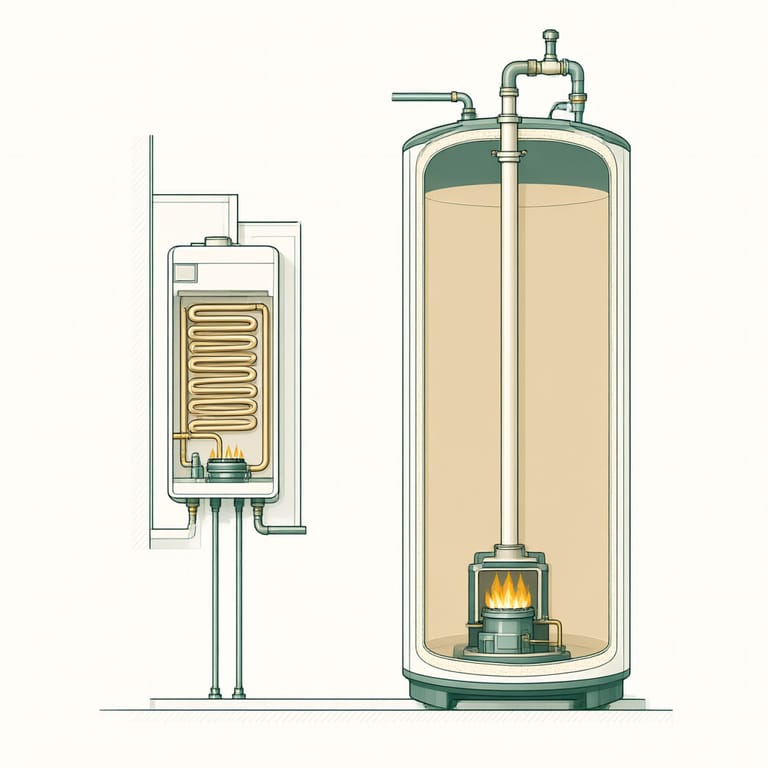
Twelve factors, side by side
| Factor | Storage tank | Tankless (on-demand) |
|---|---|---|
| Installed cost, like-for-like | $881-$1,826 typical; about $1,346 average (Angi 2026) | $1,400-$3,900 typical; conversions from a tank usually $2,500-$4,500 (Angi 2026) |
| Service life | 8-12 years, industry planning number | About 20 years per DOE; key parts are replaceable |
| Energy use | Baseline; reheats the stored reserve around the clock | 24-34% less energy at 41 gal/day or less; only 8-14% less at about 86 gal/day (DOE) |
| Hot water supply | Fixed reserve (often 40-50 gal), then a recovery wait | Continuous, but capped by flow rate (gallons per minute) |
| Simultaneous use | Handles stacked demand until the reserve runs out | Two showers plus a washer can out-draw a single unit |
| Space | Floor footprint plus clearance | Wall-hung; frees the floor |
| Maintenance | Sediment flush, anode rod checks | Descaling (annual in hard-water areas) plus inlet screen cleaning |
| Install complexity | Low: same-size swap, existing connections | Higher: venting redone, gas line often upsized, condensate drain |
| Permit and inspection | Usually permitted work; a like-for-like swap is the simpler sign-off | Permit plus gas and venting inspection; more items to pass |
| Cold-climate fit | Unaffected by incoming water temperature except for recovery time | Colder groundwater cuts usable flow; northern homes need a larger unit |
| Standby loss | Constant; the tank stays hot whether you are home or not | Near zero; fires only on demand |
| Repair economics | Cheap parts, quick fixes | Pricier parts, but one unit can outlive two tanks |
Why do plumbers not recommend tankless water heaters?
Not because the technology fails. Because retrofits bite, and the plumber is the one who has to deliver the bad news mid-quote.
An on-demand burner fires at several times the input of a conventional tank, so the pipe already feeding gas to that closet (now and then the meter too) is usually too small and must be enlarged. Venting almost always gets redone, since condensing units need their own exhaust and a condensate drain, and a botched vent is a carbon monoxide risk, not a cosmetic one. Hard water is the quiet killer: without regular descaling, scale chokes the heat exchanger years early. Then there is the "cold-water sandwich," a brief slug of cool water between back-to-back draws that surprises new owners.
None of those headaches rules the technology out; they rule out trusting any conversion bid priced like a tank swap. Gas piping and venting are licensed-professional work, not a DIY project; this is combustion equipment, not a faucet cartridge.
Whichever heater ends up on the wall, a gas supply brings one non-negotiable habit. Notice a gas odor, and everyone goes out of the house right away; on the way, touch nothing: no light switches, no lighters or matches, no phone calls. Once outside, dial 911 first and the gas company second. An installer comes after safety, never instead of it.
When you should avoid a tankless water heater
Three situations where the honest advice is to stay with a tank:
- Hard water and no appetite for maintenance. If an annual descale will not happen, the 20-year lifespan DOE credits quietly shrinks, and the premium you paid never comes back.
- Heavy simultaneous demand on a tight budget. Covering two showers and a laundry load at once means a large unit or two units, and the conversion price climbs with each.
- An all-electric house with a crowded panel. Whole-house electric tankless units pull enormous amperage; a panel or service upgrade is licensed-electrician work and can cost more than the heater.
Ready to talk to a licensed water heater pro?
Call (800) 555-0184Free call. A licensed local water heater installer picks up.Licensed water heater partners in your area- Licensed and insured partner network
- 24/7 call routing
- Free call, no obligation
- You approve the price with the installer directly
What does each path cost to own over 20 years?
EIA data puts water heating at about 18% of U.S. household energy use, the second-largest energy expense in most homes after heating and cooling. So the efficiency spread matters, but it needs honest sizing.
Say your gas water heating costs $400 a year (pull your own number from twelve months of bills). For scale, $400 buys roughly 270 therms at EIA's 2024 average residential natural gas price of $15.34 per thousand cubic feet, about $1.48 per therm. DOE's savings figure for a low-to-moderate-use home is 24-34%; call it 29%.
- Tank path: $1,346 install today, a second install around year 10 (8-12 year life), plus 20 years of fuel at $400 ($8,000). Total: about $10,700.
- Tankless path: $3,500 mid-range conversion, one unit for the duration, plus 20 years of fuel at $284 ($5,680). Total: about $9,200, before descaling costs in hard-water areas.
About $1,500 apart over two decades: real money, not life-changing money. Now run the same math for a high-use home, where DOE's savings drop to 8-14% (call it 11%): fuel falls only to $356 a year, and the tankless path lands near $10,600, within about $100 of the tank path. That is why fit decides this choice more than fuel savings do. The full year-by-year ledger, including the line items that inflate conversion bids, is in our tankless vs tank cost breakdown, and current equipment pricing lives in the tankless cost guide.
Replacing a 50 gallon tank with a tankless water heater: can it keep up?
Yes, one can replace the other, provided you size by flow rather than by gallons. Storage units are rated on capacity, the volume in the cylinder; on-demand units are rated on throughput, gallons per minute at a given temperature rise. That second number depends on your groundwater: the colder the incoming water, the harder the unit works, so the same model delivers noticeably less flow in Minnesota in January than in Georgia in July.
Practical translation: one shower plus a running faucet is comfortable territory for a mid-size unit. Run two showers while the dishwasher fills, and an undersized install shows its limits fast. An installer who asks how your household actually uses hot water, instead of just reading the old tank's label, is sizing it correctly.
Five households, five answers
- The dead-tank emergency. No hot water since last night, family of four, normal budget: swap the tank. Fastest restore, lowest cost, zero re-piping.
- The remodeler with gas at the wall. Walls already open, venting easy to route: tankless. A conversion never gets cheaper than this.
- The crowded house: six people, two of them teenagers. Heavy simultaneous draws, daily use up around DOE's 86 gallon high-use mark: a large tank, or twin tankless units if the budget stretches. The efficiency edge is smallest here.
- The part-time condo. Empty most weeks: tankless. At low use, standby loss is the bill, and this is where the 34% end of DOE's range lives.
- The all-electric house. At EIA's May 2026 average of 18.44 cents per kWh, resistance heating is the expensive way to make hot water, and electric tankless demands enormous amperage. A heat pump water heater (3.3-4.1 UEF for ENERGY STAR certified models) usually beats both; DOE's residential standards effective May 6, 2029 push electric storage units over 35 gallons that way anyway. Start with the gas vs electric comparison before deciding shape.
What's a better water heater, tank or tankless? The verdict
So, tankless or tank water heater? Tankless wins when gas is already on site, hot water use is light to moderate, you plan to stay past the ten-year mark, or floor space genuinely matters. A tank wins when the budget or the timeline is tight, when your household stacks heavy simultaneous use, or when hard water plus no appetite for annual maintenance would quietly eat the payback. Two local factors tilt the default: cold groundwater (size the tankless up or the flow disappoints) and hard water (budget the descaling or pick the tank).
If you are at the quote stage, get bids for both configurations and hold them against the ranges above; a fair conversion bid explains its gas, venting, and condensate line items. A free call to (800) 555-0184 connects you with a licensed local installer who can price both against your actual house, and you approve any work and price directly with the installer. More background on how the technology works lives in our tankless hub, and all national pricing data is collected in the cost center.
Ready to talk to a licensed water heater pro?
Call (800) 555-0184Free call. A licensed local water heater installer picks up.Licensed water heater partners in your area- Licensed and insured partner network
- 24/7 call routing
- Free call, no obligation
- You approve the price with the installer directly