
Water Heater Popping Noise and Other Tank Sounds, Explained
Pop. Pop-pop-pop, like popcorn in a steel drum, every time the burner kicks on. A water heater that talks is annoying, but also unusually honest: each sound maps to a specific physical cause, and most are cheap to fix while the problem is still only a sound. This guide starts with the classic water heater popping noise (steam under sediment), then works through rumbling, sizzling, humming, ticking, and whistling, and ends with the one sound that means shut the unit down.
Two Sounds That Mean Stop Before You Diagnose
Most tank noises are maintenance items. Two are not.
- Rolling-boil or kettling sounds from inside the tank, especially with steam, spitting, or hot water at the end of the temperature-and-pressure (T&P) relief valve's discharge pipe. That valve stays shut until heat or pressure passes its rating. Kill the energy (breaker off on electric, gas dial to OFF on gas), keep everyone clear of that pipe, and get a licensed pro on the line today. Do not cap, plug, or wire down a releasing T&P valve: International Code Council water heater safety guidance records tank explosions traced to blocked discharge lines.
- A gas odor near a gas-fired heater. Everyone out first; call 911 and the gas company once you are outdoors. On the way out, touch nothing that sparks: no light switches, no lighters, no phone until you are outside.
Match the Sound First
| What you hear | Most likely cause | Urgency |
|---|---|---|
| Popping, rumbling, popcorn sounds | Sediment layer trapping steam at the bottom | Flush soon |
| Crackling when the burner runs (gas) | Condensation dripping onto the burner | Usually harmless |
| Sizzling that does not stop | A slow leak hitting hot surfaces, or scaled elements | Check this week |
| Low hum (electric) | Element vibrating in the flow | Cosmetic |
| Ticking from pipes or the top of the tank | Thermal expansion, heat-trap nipples | Normal |
| Screeching or whistling | A partly closed valve choking the flow | Check today |
| Full-on boiling or kettling | Overheating or excess pressure | Now (red flag) |
Water Heater Popping Noise: Steam Trapped Under Sediment
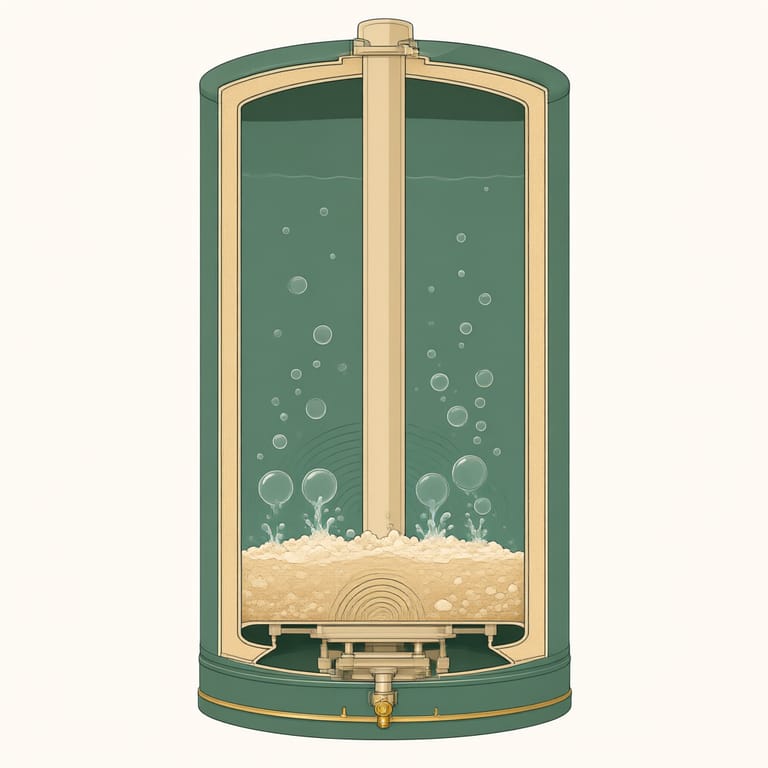
The classic water heater popping noise is a steam engine in miniature. Minerals carried in by the supply drop out and build a crust across the tank floor. Water pinned beneath that crust, touching steel the burner or lower element is heating, flashes to steam; every pop is a bubble heaving the sediment blanket upward. Rumbling is the same physics at larger scale, the whole layer shifting; harder water, faster buildup.
The blanket costs money too. Burner or element heat must now cross an insulating layer before reaching the water, and since roughly 18% of household energy use goes to heating water, per the US Energy Information Administration, a heater insulated from its own job adds a little to every bill. On a gas tank the trapped heat also cooks the bottom plate, shortening tank life.
The cure is not exciting: flush the tank. With the tank empty, have the anode rod checked; a rod eaten to its core wire means corrosion has reached the tank wall, and anode rod replacement is the cheapest way to buy a heater more years.
Two Checks That Confirm Sediment
Check one is timing: sediment popping happens only while the heater is actively firing (recovery after showers or laundry) and stops once the thermostat is satisfied; noise that ignores the cycle has another cause. Check two is the one-gallon test: hose on the drain valve, about a gallon into a bucket, let it settle; grit like fine sand or cloudy white flakes at the bottom is sediment. Gloves on, kids out: that water comes out scalding hot. An older plastic drain valve that refuses to reseal afterward calls for a pro visit, not panic.
Sizzling and Crackling: Moisture Meeting Heat
On a gas heater, a brief crackle after a heavy hot-water draw is usually condensation: cold supply chills the tank, moisture beads on the outside, drops land on hot burner parts, and the crackle fades as the tank warms. Sizzling that continues once the tank is fully hot points to a small leak above the burner compartment, so inspect the jacket and floor at the base for rust streaks and damp patches.
On an electric tank, ongoing sizzling or hissing generally means scale-crusted heating elements boiling the film of water touching them. Crusted elements run hotter than designed, burn out sooner, and eventually trip the high-limit reset button. Symptom list, 240V warning, and pricing live on the heating element replacement page.
Humming and Ticking: The Harmless Section
An electric element mounted crosswise in circulating water can vibrate at a pitch you hear as a low hum. Nothing is damaged; a licensed pro can tighten it a fraction of a turn and the hum usually stops.
Ticking is normally the plumbing rather than the heater: hot lines rubbing framing as they warm, or heat-trap nipples on top of the tank doing what a check valve does. Ticks that follow hot-water use and taper off are ordinary house noise.
Whistling and Screeching: Something Is Choked
A sharp whistle or screech is water squeezed through a gap narrower than the flow wants. Prime suspect: a valve left partly shut, often the cold inlet valve after recent work on the heater. Make sure the handle is fully counterclockwise, or a lever-style handle lines up with the pipe. If every valve is wide open and the scream continues, a failing or restricted valve on a pressurized tank needs a licensed pro's eyes.
Ready to talk to a licensed water heater pro?
Call (800) 555-0184Free call. A licensed local water heater installer picks up.Licensed water heater partners in your area- Licensed and insured partner network
- 24/7 call routing
- Free call, no obligation
- You approve the price with the installer directly
Boiling and Kettling: The Tank Is Overheating
A true rolling boil means water far hotter than any thermostat setting should permit. On an electric heater the typical culprit is a thermostat or high-limit control welded closed; on a gas heater, a gas control valve that refuses to shut the burner down. On either fuel, a closed plumbing system without a working expansion tank can ratchet pressure higher each heating cycle. None of this is a homeowner repair: energy off, then a licensed pro to test control and pressure in one visit.
What You Can Safely Do Yourself, and Where to Stop
Reasonable for a careful homeowner: the timing check, the one-gallon test, confirming inlet and outlet valves are wide open, a moisture check at the base and fittings, and a complete flush by the linked guide.
Hand it to a licensed pro for anything behind an electric access panel (elements and thermostats live on 240V circuits), anything at the gas burner, gas control valve, or flue (carbon monoxide territory), any work on the T&P valve or its discharge pipe, or a tank boiling or leaking through its shell.
Red Flags: Call Now
- Boil or kettle sounds inside the tank, or steam and hot water spitting from the T&P discharge pipe.
- Popping with moisture: rust-colored hot water or a damp ring at the base marks a tank in its final stretch, not a maintenance candidate.
- A whistle or screech that keeps going with every valve wide open.
- Sizzling that stays once the tank is fully hot, plus damp spots or rust streaks on the jacket.
- Any gas odor (get out first, as above, then make calls).
For any of those, (800) 555-0184 reaches a licensed, insured water heater pro near you. The call costs nothing, partner installers pick up 24/7 including weekends, and every job and price gets your direct approval with the installer.
What Each Sound Costs to Fix in 2026
| Sound | Likely fix | National range (2026) |
|---|---|---|
| Popping, rumbling | Professional flush | $100-$350 (HomeGuide small-fix range) |
| Rumbling on an older tank | Anode rod, replaced during the flush | $150-$350 installed; the rod itself is $20-$50 (HomeGuide) |
| Sizzling on electric | Heating element | $100-$350 (HomeGuide) |
| Boiling on electric | Thermostat or high-limit control | $100-$350 (HomeGuide) |
| Boiling on gas | Gas control valve | $200-$750 (HomeGuide) |
| Popping plus a leak from the shell | Tank replacement | $881-$1,826 typical, about $1,346 average (Angi) |
For perspective, Angi's 2026 repair data places a typical water heater repair at $228-$1,017 (roughly $600 on average), and Angi's replacement guide treats 8-12 years as a storage tank's planning horizon; a yearly flush and an anode rod check every 3-5 years push a tank toward the top of that range.
Quick Answers
Is a popping water heater dangerous?
On its own, no. Popping is sediment and steam, a maintenance and efficiency issue rather than a blast hazard. Ignored for years, though, the tank tends to die young, so treat it as a deadline rather than an emergency.
Will flushing stop a water heater popping noise for good?
Usually, if the sediment is still loose enough to exit through the drain valve. On an older tank where the layer has baked into a hard crust, only part may come out and the popping returns within weeks. At that point tank age decides, and the repair or replace guide lays out the numbers.
If It Is None of These
A sound matching no row above earns a diagnosis, not a guess. The repair library holds more symptom guides, and (800) 555-0184 connects you with a licensed local pro who will listen to the tank and quote before anything gets touched.