
Gas or Electric Water Heater: Let the Fuel Math Decide
Nationally, the gas or electric water heater question is a coin flip: per EIA household data, natural gas heats the water in about 48% of U.S. homes and electricity in about 46%. In your basement it is rarely a coin flip. One fuel is already plumbed, wired, and vented, and that head start usually decides the rematch. Forget the abstract "which fuel wins" debate. Two questions have real answers: what a unit of hot water costs you on each fuel, and what crossing over would cost up front. This page works out both, then gives a verdict by household.
First rule: the fuel you have is the favorite
A like-for-like replacement (gas for gas, electric for electric) reuses your venting, your gas piping or 240-volt circuit, and your drain layout. Cross the fuel line and you pay for new infrastructure before the heater itself: a conversion to gas needs a licensed gas fitter to run and pressure-test piping plus a code-compliant flue, while going electric can mean a new 240V circuit and, in older homes, a panel review.
So the honest default is to replace on the same fuel unless the operating-cost math below or your long-term plans argue otherwise. If your gas unit is failing right now, the gas water heater replacement guide covers the swap itself.
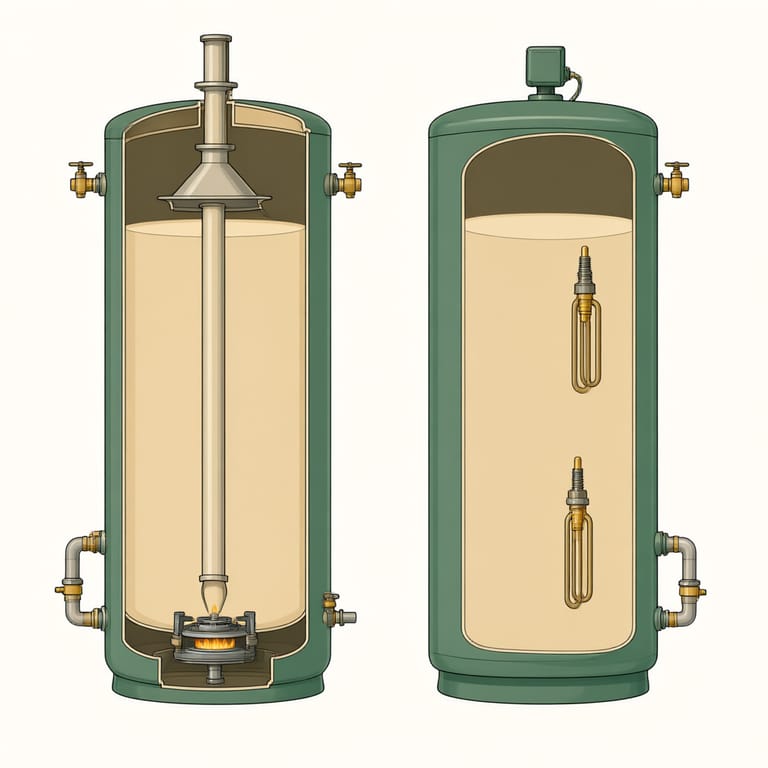
Gas or electric water heater: which costs less per unit of hot water?
Whether it is cheaper to heat hot water with gas or with an electric element comes down to what each fuel charges per BTU. Two national prices, both from EIA:
- Electricity: 18.44 cents per kWh, U.S. residential average, May 2026 (EIA Electric Power Monthly, Table 5.6.A)
- Natural gas: $15.34 per thousand cubic feet, 2024 annual residential average (EIA); per therm, that is roughly $1.48
A therm of gas carries 100,000 BTU; use that block of heat as the yardstick. Electricity delivers it in about 29.3 kWh (3,412 BTU per kWh), a $5.40 purchase at the rate above. The burner buys the same block for $1.48 before anything goes up the flue. Raw fuel gap: about 3.6 to 1 in favor of gas.
Efficiency narrows that gap but cannot close it for a standard electric tank. Almost every watt a resistance element draws ends up in the water (roughly 0.90-0.95 UEF, the DOE efficiency metric printed on every model's spec sheet), while a burner sends part of its heat up the flue. Even so, at these prices gas delivers hot water at well under half the electric-resistance cost per BTU. For your own unit, divide $1.48 by its UEF: a tank rated 0.60 UEF, for example, lands at about $2.47 per 100,000 BTU delivered.
So yes, gas is the cheaper fuel to run, provided the contest is burner against resistance element. One machine rewrites that table; it gets its own section below.
Eleven differences that actually matter
| What you are comparing | Gas (natural gas) | Electric (resistance tank) |
|---|---|---|
| Fuel cost per 100,000 BTU | About $1.48 before flue losses (EIA 2024 average) | About $5.40 (EIA May 2026 average) |
| Typical installed cost | Usually the higher end of the $881-$1,826 tank range (Angi 2026) because venting adds labor | Usually the lower end of the same range; the simplest install in the trade |
| Recovery speed | Fast; large burner input | Slower; elements heat less water per hour |
| Efficiency (UEF) | Loses some heat up the flue | About 0.90-0.95; nearly all input becomes hot water |
| Upgrade ceiling | Condensing or tankless gas | Heat pump water heater at 3.3-4.1 UEF, the efficiency champion |
| Venting | Required: flue or sidewall vent plus combustion air | None |
| Safety profile | Combustion: gas leaks, carbon monoxide, flammable-vapor rules | 240V circuit; no combustion byproducts |
| Space and placement | Needs vent routing and clearances | Goes almost anywhere with a circuit |
| Power outage | Some models keep working (standing pilot) | Down until power returns |
| Expected lifespan | 8-12 years for a storage tank of either fuel (industry planning figure, Angi) | Same 8-12 years; heat pump units plan around 10-15 |
| 2029 federal rules | Minor standard updates | Standard electric tanks over 35 gallons must move to heat pump technology (DOE, May 2029) |
Safety: what each fuel asks of you
Combustion comes with one non-negotiable protocol. Catch that sulfur, rotten-egg smell (the odorant utilities add to gas) near the heater or anywhere in the house, and the only job is to get everyone out. Touch no light switch, strike no flame, pick up no phone inside; from outdoors or a neighbor's, call 911 and the gas utility, and let them hunt for the leak. Leaks aside, a burner depends on sound venting to keep carbon monoxide out of living areas, and flue work and fuel-line connections belong to a licensed professional, not a free weekend. A CO alarm within earshot of the bedrooms is the cheapest protection any combustion household can buy.
Electric is calmer but not casual. The circuit feeding a water heater runs at 240 volts; nobody touches a wire until the breaker is off and a meter confirms the terminals are dead. Treat 240V work as licensed-pro work. What electric skips is combustion: no flue, no CO, no flammable-vapor clearances.
Neither fuel is "dangerous" installed correctly; they fail differently, and combustion failures escalate faster.
Is my water heater gas or electric? Check in thirty seconds
Start at the top of the tank: a metal exhaust pipe climbing to the ceiling or out through a wall belongs to a burner, so gas. Now the bottom third: a small access cover with a sight glass or an igniter button also says burner. An electric unit shows neither; instead a cable or conduit enters at the top or side and, usually, two flat rectangular element covers sit on the tank's side. Read those covers from the outside only; live 240-volt terminals hide behind them. The rating plate is the tiebreaker: it prints fuel type, capacity, and serial number, and the manufacturer spec sheet for that model supplies the UEF for the math above.
While you are there, note capacity and model number; every phone quote gets faster with both.
Switching fuels: worth it from electric to gas, or gas to electric?
Electric to gas pencils out only if gas service already reaches the house (say, a line feeding the furnace) and the meter has capacity. You are buying the 3.6-to-1 fuel-cost advantage, but paying for piping, venting, and a licensed fitter first, often more than the heater itself. With no service at the property yet, a new connection usually kills the payback on a water heater alone.
Gas to electric rarely makes sense into a resistance tank, because every BTU of raw fuel would then cost you about 3.6 times as much. It makes a lot of sense into a heat pump unit, especially where electricity is cheap, your current bill carries a high fixed monthly charge, or an all-electric home is the plan anyway.
Either direction, price the infrastructure separately from the heater; a blended bid hides where your money went. National equipment and labor figures for every configuration are in the cost center.
Ready to talk to a licensed water heater pro?
Call (800) 555-0184Free call. A licensed local water heater installer picks up.Licensed water heater partners in your area- Licensed and insured partner network
- 24/7 call routing
- Free call, no obligation
- You approve the price with the installer directly
The heat pump wrinkle: electric's comeback
A heat pump water heater spends its electricity on a compressor, not a glowing element, pulling warmth from the surrounding air into the tank. Certified units run 3.3-4.1 UEF per ENERGY STAR, three to four times what a resistance tank wrings from each kWh. Redo the math: $5.40 per 100,000 BTU divided by a UEF of 3.7 is about $1.46 of delivered heat, right at parity with gas, and without combustion, venting, or CO.
For a family of four, ENERGY STAR's estimate is roughly $550 a year saved against a standard electric tank, more than $5,600 across the unit's life. Two honesty notes for 2026. The federal 25C tax credit, per the IRS, is gone for any unit put into service after December 31, 2025, though many state and utility rebate programs still pay out. And DOE's 2029 standards push most larger electric storage units onto heat pump technology, so the rules already tilt this way. Budget for air volume, a condensate drain, and some compressor hum; the ledger below prices it. Details and install requirements are in the heat pump water heater guide.
Electric water heater disadvantages, and what offsets each
At current EIA prices a resistance tank pays more per BTU than any other mainstream option; its raw fuel runs about 3.6 times what natural gas costs for the same heat. Recovery after heavy use is slower, because two elements add less heat per hour than a burner. When the power goes out it produces nothing, while a standing-pilot gas unit keeps going. And whole-house electric tankless demands amperage many existing panels cannot supply.
Each has a mitigation: a bigger tank or a hybrid heat pump mode, off-peak utility rates where offered, a generator circuit in outage-prone areas. For balance, the burner has downsides too: venting raises the installed price, it carries leak and CO risk that electric does not, more parts can fail (thermocouple, gas valve, venting), and fuel-side work needs a licensed fitter.
The operating-cost table, all three ways
| Technology | Cost per 100,000 BTU delivered | Basis |
|---|---|---|
| Gas storage tank | $1.48 divided by your unit's UEF (example: about $2.47 at 0.60 UEF) | EIA 2024 fuel price; UEF from the unit's spec sheet |
| Electric resistance tank | About $5.70-$6.00 | $5.40 raw at 0.90-0.95 UEF (EIA May 2026 price) |
| Heat pump water heater | About $1.32-$1.64 | $5.40 raw at 3.3-4.1 UEF (ENERGY STAR range) |
That middle row is why the jump to a heat pump unit, not a fuel switch, is usually the bigger lever.
The 15-year ledger
Total cost of ownership, with every input sourced above. Start with your own annual water-heating spend (EIA puts water heating at about 18% of a household's energy use, so roughly a fifth of an all-electric home's electric bill is a fair first estimate), then apply the delivered-heat figures from the table:
- For every $100 a year a resistance tank costs you, a gas tank at the 0.60 UEF example would cost about $41-$43, and a heat pump unit about $22-$29.
- Over 15 years, each $100 of annual resistance spend becomes $1,500; the same hot water costs roughly $615-$645 on gas and $330-$435 on a heat pump unit.
Now add the equipment. Angi's 2026 national figures put a tank-style replacement at $881-$1,826 installed (average about $1,346), and a heat pump water heater at $3,200-$4,700 (average about $4,200). Against ENERGY STAR's $550-a-year saving for a family of four, the roughly $2,850 heat pump premium pays back in about five years, then runs ahead for the rest of a 10-15 year service life. A fuel switch has no such clean formula, because piping, venting, or circuit work is priced per house; divide that quote by your annual gap from the bullet above for your own break-even in years. On the same fuel, the 15-year winner on operating cost is the burner. Crossing fuels, the winner is almost always the heat pump unit, not the fuel switch.
Does the answer change for tankless?
Mostly no; it sharpens. Gas tankless units are the mainstream product: large burner input, endless hot water at rated flow, and every combustion appliance's venting and fuel-line obligations, scaled up. Whole-house electric tankless is the niche case: instant resistance heating often needs several dedicated circuits, more than some homes' entire service capacity, so it fits new construction with oversized panels, warm-groundwater regions, or single-fixture duty. If you are weighing the on-demand format at all, the shape question (tank or tankless) comes before the fuel question; that is the tankless vs tank comparison.
Which fuel, by household
- Gas tank died, line and flue in place: replace like for like. Fastest, cheapest per BTU, no new infrastructure.
- Electric tank died, tight budget, small household: replace with electric; the 50-gallon electric tank cost data shows why it is the cheapest install on the menu.
- Electric tank died, garage or big basement, staying long-term: heat pump unit. Operating cost on par with a burner, no combustion, and it front-runs the 2029 rules.
- All-electric new build: heat pump, almost without exception.
- High-demand household already on gas, eyeing endless showers: stay put and read the tankless vs tank comparison; that is a shape decision, not a fuel decision.
- No gas at the street: do not buy a service line for a water heater. Electric (ideally heat pump) wins by default.
What is better, a gas or an electric water heater?
At the EIA prices above, gas beats electric resistance by about 3.6 to one on raw fuel cost, and still by more than two to one on delivered heat once flue losses are counted in the ledger. A heat pump water heater erases the gap and turns "electric" into the efficiency pick rather than the expensive one. Switch fuels only when the infrastructure is already mostly there; otherwise put that money into better technology on the fuel you have. If your profile was in the list above, you have your answer.
Ready to price a gas or electric water heater for your actual basement? A free call to (800) 555-0184 connects you with a licensed, insured local installer who can quote either fuel against your venting and panel; check every number they give you against the ranges on this site.
Ready to talk to a licensed water heater pro?
Call (800) 555-0184Free call. A licensed local water heater installer picks up.Licensed water heater partners in your area- Licensed and insured partner network
- 24/7 call routing
- Free call, no obligation
- You approve the price with the installer directly