
Electric Water Heater Replacement: Costs, Options, and the 2029 Rule
This purchase now has a date on it. The Department of Energy has finalized a rule that, from May 6, 2029, requires any new electric storage tank above 35 gallons to be built on heat pump technology (DOE final rule). Staring at a dead 50-gallon tank in 2026? The plain resistance tank on the shelf today is the last of its line; the next swap will almost certainly be a heat pump unit. So treat this electric water heater replacement as the moment to run the comparison rather than defaulting to whatever is on the installer's truck. Electricity heats the water in roughly 46% of American homes (US Energy Information Administration), so the arithmetic below applies in a lot of basements.
Rather have it swapped than debated? Call (800) 555-0184. The call costs nothing; Embercrest puts you through to a licensed, insured installer near you, and you settle the price with that pro.
If the tank is leaking right now
Three moves, in order, before anything else:
- Kill the power at the panel. Flip the heater's breaker (the double-pole 240-volt one); in a leaking electric unit the danger is water reaching live elements or wiring.
- Shut the cold supply. Find the valve on the cold line entering the top of the heater; closing it stops the tank refilling.
- Give the water an exit. If the floor is flooding, thread a garden hose onto the drain spigot and route it to a floor drain or out a door. Feet out of the puddle, hands off the wiring.
With that handled, pick up the phone; everything below is about choosing well.
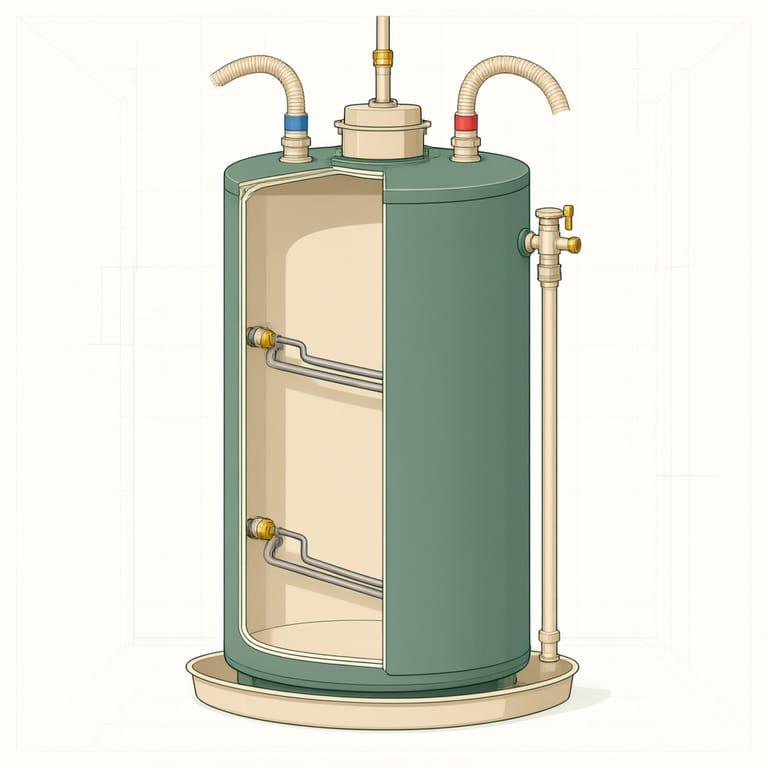
Signs you need a new tank, not a $100-$350 part
Electric tanks are among the most repair-friendly water heaters made; two inexpensive parts sit behind many "it died" calls:
- Heating elements. A tank gone quiet that delivers lukewarm or no hot water is the classic burned-out element: $100-$350 replaced by a pro (HomeGuide 2026 data). The element replacement page covers the diagnosis.
- Thermostats. Too hot, too cold, or cycling oddly points at the paired thermostats, the same $100-$350 repair bracket.
- A tripped high-limit reset. One trip can be a fluke; a reset that keeps tripping points to an element or thermostat on its way out, not a dead tank.
What no part can rescue: water weeping from the tank shell or its seams, hot water that runs rust-tinted while the cold side stays clear, or a unit deep into the industry's 8-12 year planning life (Angi) that has broken down twice in a year. The corrosion clock has run out; swapping parts only postpones the invoice. A useful shorthand: a repair quote past half the price of a new tank, on a unit past mid-life, is replacement money.
Resistance tank or heat pump: the numbers side by side
Both are electric units, typically on a 240-volt circuit; they earn their keep very differently. National residential electricity averaged 18.44 cents per kWh in May 2026 (EIA Electric Power Monthly), which makes efficiency the headline number:
| Factor | Standard resistance tank | Heat pump (hybrid) tank |
|---|---|---|
| Installed cost (2026) | $881-$1,826; avg ~$1,346 | $3,200-$4,700 typical; avg ~$4,200 |
| Efficiency (UEF) | ~0.9-0.95 | 3.3-4.1 (ENERGY STAR certified models) |
| Typical service life | 8-12 years | 10-15 years |
| Running-cost picture | Baseline | about $550 a year saved, four-person household (ENERGY STAR estimate) |
| Install requirements | Existing 240V circuit, standard footprint | 240V, condensate drain, enough surrounding air volume, plus extra height for the compressor |
Cost ranges: Angi 2026; efficiency and savings: ENERGY STAR; service life: industry planning figures (Angi, ENERGY STAR).
The verdict by scenario. Garage or roomy basement, household of three or more, staying longer than the roughly five-year payback (a $2,900 price gap against ENERGY STAR's ~$550 a year): the heat pump's math is strong. Cramped interior closet, small or short-term household, or a panel with no headroom: the standard electric resistance tank remains the rational buy; the 2029 standard applies to new units, not the tank already in your home. Tempted to switch fuels instead? The gas vs electric comparison runs that arithmetic; the FAQ below covers what a fuel switch adds.
One warning on incentives: the federal 25C credit, which used to return 30% of heat pump water heater costs, no longer applies to equipment put into service after December 31, 2025 (IRS). A 2026 quote that dangles it is a red flag. State programs and utility rebates still exist; confirm them before signing.
What electric hot water heater replacement costs in 2026
For a like-for-like electric resistance tank, Angi's 2026 national data puts the installed job at $881-$1,826, averaging about $1,346, with the full spread running $600-$2,500 by tank size and site conditions. A heat pump unit installed runs $3,200-$4,700 (average near $4,200). Heating water eats roughly 18% of the energy a household consumes (EIA), so the operating side of that gap deserves as much attention as the sticker.
What moves the number on an electric job:
- Tank size and location. A 50-gallon unit in a garage is the easy case; 75-80 gallon tanks, attics, and tight closets cost more. The 50-gallon electric cost breakdown itemizes the common case.
- Electrical scope. Same spot, healthy existing 240-volt circuit: that is the base price. A heat pump unit or a larger tank that needs a new circuit or panel work adds an electrician's line; have it priced separately.
- Code catch-up. A drain pan where required, an expansion tank on closed systems, a compliant T&P discharge pipe, seismic strapping in some states. These are what the inspector checks, not upsells.
- Permit, haul-away, and timing. Plenty of local codes want a permit even when the new tank matches the old one (see the permit guide); hauling off the old unit and after-hours scheduling show up as their own lines.
Ready to talk to a licensed water heater pro?
Call (800) 555-0184Free call. A licensed local water heater installer picks up.Licensed water heater partners in your area- Licensed and insured partner network
- 24/7 call routing
- Free call, no obligation
- You approve the price with the installer directly
How the electric swap goes, from your side
An electric water heater replacement is half plumbing, half electrical, and the electrical half is licensed-pro territory. The rule a good installer follows, and the one to watch for: breaker off, then the circuit verified dead at the heater with a meter, because panels get mislabeled.
- The call and the quote. Have three facts ready: tank capacity, where it lives, and whether the panel has spare capacity (a photo of the nameplate and the panel label saves a visit). A good installer quotes an itemized range from that.
- Install day. Power off and proven dead, tank emptied through a hose, supply lines and the 240V connection undone, old unit carried out. The new tank goes in (on a pan where code asks for one), gets connected, and is filled to the top before any power touches it; elements energized in an air pocket ("dry firing") cook themselves in seconds.
- Sign-off. The relief valve gets tested and its discharge pipe checked: full diameter, air gap, never capped, because blocked discharge lines have blown tanks apart (ICC guidance). Thermostats get set: 120F is the CPSC's scald-prevention setting; if someone in the house is immunocompromised, ask about storing hotter with a mixing valve at the fixtures, since Legionella survives 120F storage (OSHA guidance).
No venting, no fuel line, no combustion air: the water is off for hours, not days, which is why electric swaps sit at the calmer end of replacing any water heater.
Electric water heater replacement near me: how the dispatch call works
Embercrest publishes; it does not install. The number on this page reaches a dispatch line that hands you to a licensed, insured installer partner working your area; the call costs nothing, carries no obligation, and every dollar gets approved by you, directly with the pro. Expect a few questions (capacity, location, resistance or heat pump) and a written, itemized quote. Push back on one round number with no breakdown, a "fuel surcharge" on a local job, or a heat pump pitch that never asks about closet size or where the condensate will drain.
Three pushbacks worth having
- "The quote is double the store price." The other half is labor, haul-away, the permit, and code items; ask for them itemized and question anything unexplained.
- "A heat pump unit sounds like a gadget." It is a compressor on a tank: mature tech with federal standards now built around it. The real caveats are space, mild compressor noise, and cool exhaust air, not reliability.
- "I could DIY this." Maybe; the FAQ below spells out the line. The 240-volt circuit is where most homeowners should stop, and an unpermitted swap can surface at sale time.
Signs the tank is finished: time to call
- Water from the tank shell or its seams, not from a fitting.
- Hot water arrives discolored while the cold side runs clean.
- The breaker or the high-limit reset trips repeatedly, or there is a burnt smell or scorched insulation at the junction box.
- The relief valve discharges repeatedly, or its discharge pipe is capped.
- No hot water from an electric unit past 10 years, or the second breakdown in a year.
Want a real number for your house instead of a national range? Call (800) 555-0184. One call lines up the swap with a licensed, insured installer, plus a quote you can hold against every figure on this page.
Ready to talk to a licensed water heater pro?
Call (800) 555-0184Free call. A licensed local water heater installer picks up.Licensed water heater partners in your area- Licensed and insured partner network
- 24/7 call routing
- Free call, no obligation
- You approve the price with the installer directly