
Water Heater Element Replacement: Symptoms, Cost, and Where DIY Stops
The shower runs warm for a few minutes, then slides to cold. On an electric hot water heater that almost always means one of the two heating elements has burned out. The part is cheap; the 240 volts and the scalding tank around it are not, and the failure is often misread as "time for a new heater." Diagnosed correctly, a water heater element replacement is one of the cheapest repairs in the trade. Prefer a pro today? Dial (800) 555-0184; the call reaches a licensed, insured installer in Embercrest's partner network.
Before any access panel comes off: residential electric tanks run on 240-volt circuits, enough to kill. Cut the circuit at the panel and prove it dead at the terminals with a non-contact voltage tester; no tester, no DIY, call a licensed pro. Draining is its own hazard: at a 140F setting, water causes a third-degree burn in about six seconds (CPSC exposure tables), so let the tank cool before opening the drain valve.
Upper or lower? The symptoms tell you
Roughly 46% of US households heat water with electricity (EIA data), and a standard electric tank carries two elements that never run together; the upper thermostat decides which gets power, so the failure patterns read clearly:
| What you are experiencing | Likely failure |
|---|---|
| No hot water at all | Upper element (it runs first), or no power reaching the unit |
| Hot water that runs out fast or stays lukewarm | Lower element, which does the bulk heating |
| Temperature swinging hot and cold, or scalding spikes | Usually the thermostat: see the thermostat replacement guide |
| Breaker trips, or the red reset button keeps tripping | A grounded element or a thermostat stuck on; stop resetting and get it tested |
To confirm, continuity-test across the two terminals with a multimeter: no continuity means a dead element, a reading to the tank body means a grounded one. If both test fine and the tap still runs cold, work through the no-hot-water diagnostic before buying parts.
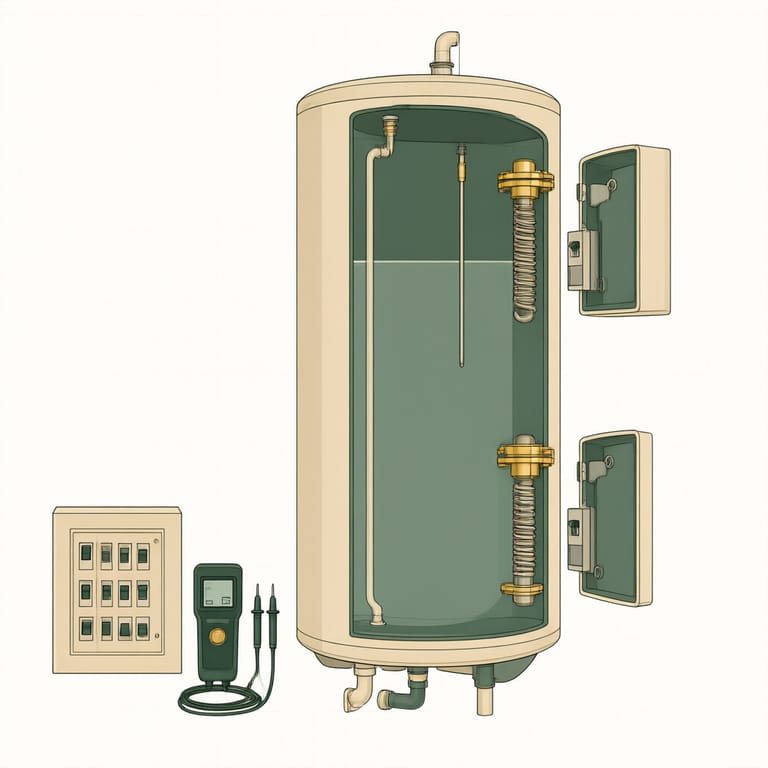
What heating element replacement on a water heater involves
A pro visit runs a tight sequence. Breaker off and verified dead; panels and insulation out of the way; both elements and both thermostats tested, so the part that actually failed is the one replaced. You get a price and approve it with the installer before a wrench turns. Then the tank is drained, the old one comes out, threads are cleaned, a new gasket is seated, then the step that prevents a callback: the tank refilled completely, air purged from a hot tap, before power comes back on. Energized dry, it burns out in seconds. A leak check at the port under pressure closes the visit.
Matching matters more than brand. The replacement element has to agree with the old one on voltage, wattage, and mount style (screw-in on modern tanks, bolt-in on some older units); the specs are on the part's face or the water heater's data plate. Parts list: the matching element (some people call it a coil), a fresh gasket, the socket.
What replacing a water heater element costs in 2026
This repair runs $100 to $350 nationally, per HomeGuide's 2026 repair-cost data; parts are a small slice, and you mostly pay for diagnosis, drain time, and the electrical discipline above. Angi's 2026 numbers put the typical water heater repair at $228-$1,017 (average about $600), so this is one of the cheaper diagnoses. What pushes the bill up: heavy sediment around the lower port, seized threads on an older tank, or a failed thermostat that took the part with it (then you pay for both). Full line items sit in the element replacement cost guide.
Ready to talk to a licensed water heater pro?
Call (800) 555-0184Free call. A licensed local water heater installer picks up.Licensed water heater partners in your area- Licensed and insured partner network
- 24/7 call routing
- Free call, no obligation
- You approve the price with the installer directly
When the element is worth replacing, and when the water heater is past saving
Numbers-first: a $100-$350 swap on a five-year-old tank is easy money against $881-$1,826 for a new installed tank (Angi, 2026). The same swap on a tank at the end of the 8-12 year planning life Angi and manufacturers cite is a harder sell, and a deadline sharpens it: under the Department of Energy's 2029 efficiency standards, which take effect May 6, 2029, new electric storage units over 35 gallons must use heat pump technology. Today's full-size resistance tanks are the last of their kind, and their heat pump successors cost more (Angi's 2026 data: $3,200-$4,700 installed). If this failure is the first of several on an aging tank, price a replacement now; the repair hub walks through that math.
Three hesitations, answered straight
"Up to $350 for a part this cheap?" You are buying a correct diagnosis, a safe 240V shutdown, a drain that does not flood the closet, and a refill that does not dry-fire the new part. Skip one and the cheap repair gets expensive.
"Will this make a mess, and how long am I without hot water?" The tank drains to a floor drain or out a hose; count on the visit length plus reheat time.
"I could just do this myself." Plenty of homeowners do. The non-negotiables: breaker-plus-tester verification, a complete refill before power, the right part spec. If any of those gives you pause, the $100-$350 buys you out of the risk.
Call a pro now instead of testing further if
The breaker trips the moment the heater energizes, you see scorched wiring or melted insulation at a terminal, a port is weeping, or the tank shows rust streaks below the panels.
Want the diagnosis right on the first visit? Call (800) 555-0184 for a water heater element replacement quote; the call reaches a licensed, insured partner installer, and you settle the price with that installer before work begins.
Quick answers
Can I replace the element myself? The element itself, yes, if you can verify the circuit is dead with a tester, drain the tank, and match voltage, wattage, and mount. Damaged 240V wiring or a tripping breaker is licensed-pro work.
How do I know which element is bad? Continuity-test both. Nothing hot at all points upper; short-lived or lukewarm points lower. Thermostat failures imitate both.
Is water heater lower element replacement different from the upper one? Same part, same procedure; the lower port sits in the sediment zone, so expect more drain time.
Is there a heating element inside a gas water heater? There is not; a gas tank heats from a burner at its base, and burner or gas valve work stays licensed-pro only. Smell gas? Everyone out of the building first, then call 911 and the gas utility from outside; touch no switches, strike no flame, no phones until you are out. Quoted a replacement element for a gas unit? Get a second opinion.
Why is there still no hot water after a new element? The tank was not fully refilled before power-up (dry-fired in seconds), the thermostat that switches it failed too, or the breaker never got reset.
Ready to talk to a licensed water heater pro?
Call (800) 555-0184Free call. A licensed local water heater installer picks up.Licensed water heater partners in your area- Licensed and insured partner network
- 24/7 call routing
- Free call, no obligation
- You approve the price with the installer directly