
Tankless Water Heater Cost vs Tank: Every Line Item, 20 Years Out
Put the two invoices side by side and the tankless water heater cost vs tank cost gap looks simple: a replacement tank averages about $1,346 installed, while a tank-to-tankless conversion commonly lands between $2,500 and $4,500 (Angi, 2026 national data). Call it a $2,000 spread. Whether those $2,000 ever come back to you is not a slogan. It is a ledger with three inputs: how long you stay in the house, how much hot water you use, and what your conversion bid leaves off the paper. This page runs that ledger line by line, through year 20.
Tankless water heater cost vs tank: the installed prices, itemized
Eleven parameters, money first. National price figures are Angi's 2026 data; efficiency and tankless-life figures come from the U.S. Department of Energy; the tank planning life is the industry figure Angi and manufacturers use, and the anode schedule comes from the same guidance.
| Line item | Tank replacement | Tank-to-tankless conversion |
|---|---|---|
| Typical project total | $881-$1,826 (average about $1,346) | $1,400-$3,900; conversions usually $2,500-$4,500 |
| Equipment share of the bill | The bulk of it | Smaller than you expect; gas line, venting, and electrical push conversions to the top of the range (Angi) |
| Gas line work | Rarely needed | Common: an on-demand burner needs far more gas per minute than a storage burner, so the line is often upsized |
| Venting | Reuses the existing flue | New dedicated venting; condensing models add a condensate drain |
| Electrical | None for an atmospheric gas unit; power-vent models need an outlet | An outlet for ignition and controls, if none exists |
| Permit and inspection | Usually required, modest fee | Usually required; more items to inspect |
| Haul-away and disposal | Small line item | Same |
| Annual fuel, low-to-moderate use | Baseline | 24-34% less at 41 gallons a day or under (DOE) |
| Routine maintenance | A flush now and then; anode rod replaced on a 3-5 year cycle | Descaling on the manufacturer's schedule (more often where water is hard); inlet filter cleaning |
| Planning life | 8-12 years (industry figure) | About 20 years (DOE) |
| Repair pattern | Cheap parts until the vessel leaks, then replacement | Pricier parts, but the unit is rebuilt around a durable heat exchanger |
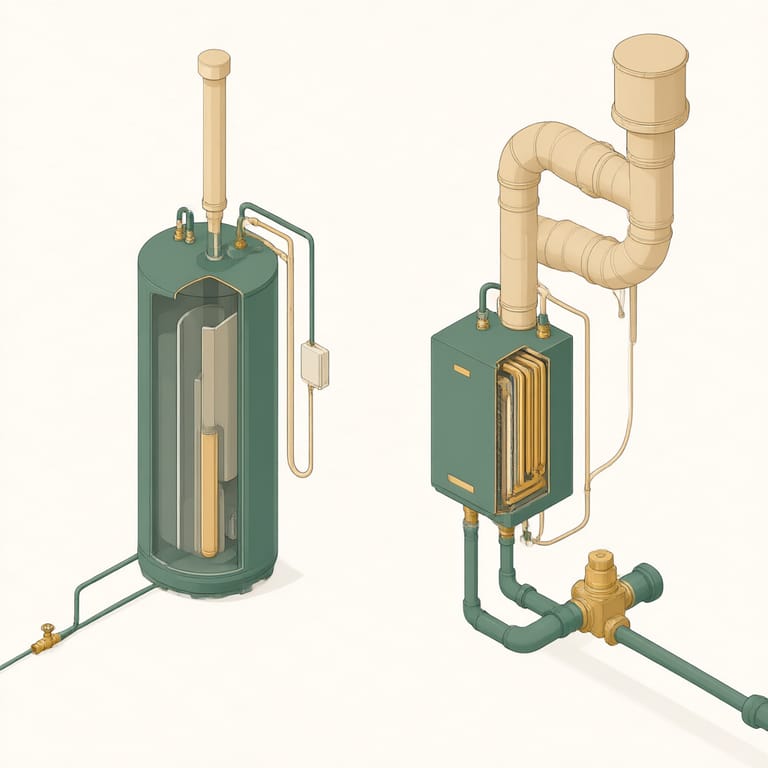
The tank column is boring on purpose: a same-fuel swap reuses everything. The tankless column is where bids diverge by thousands, and the spread is almost never the heater itself. It is the gas line, the venting, and the wall the installer has to open to route them. Current unit-by-unit pricing is tracked in our tankless cost guide.
What moves each number
A tank bid climbs with capacity, with a switch from atmospheric to power venting, and with code catch-ups: an expansion tank, a drain pan, seismic straps in the states that call for them. Even fully loaded, it rarely escapes its range.
A tankless bid climbs with flow rating (bigger burner, bigger gas demand), distance from the gas meter, exterior-wall access for venting, and condensate routing. A conversion quoted at tank-swap money either found ideal conditions or left something off the paper. Ask which.
One safety point belongs in every conversion conversation: sizing the gas line, making the gas connections, running the vent, and adding any electrical circuit are jobs that need a permit and a licensed trade. A vent run the wrong way is a carbon monoxide problem, not a cosmetic one, so the inspection fee on the bid buys something real. Then the rule that sits above every line item once gas is involved: a gas smell means everyone walks out of the house right away, and the calls to 911 and the gas utility happen from the yard, never from inside. Nothing gets switched on or off on the way out, nothing gets lit, and phones stay in pockets until you are outdoors. No bid, and no page, comes before that.
The 20-year ledger
Assumptions, stated plainly. Energy prices held flat. A $400-a-year gas water-heating bill, which is roughly 270 therms at the EIA's 2024 average residential natural gas price of $15.34 per thousand cubic feet (about $1.48 a therm); substitute your own number from twelve months of bills. The storage unit is replaced once at year 10, since the industry planning life is 8-12 years, and one tankless unit serves the full period, which lines up with the U.S. Department of Energy's own service-life figure of roughly 20 years for demand-type units. DOE's saving figure for tankless, 24-34%, applies to homes drawing roughly 41 gallons of hot water daily or less; the ledger takes the midpoint, 29%.
| Cost through | Tank path | Tankless path |
|---|---|---|
| Day one (installed) | $1,346 | $3,500 (mid-range conversion) |
| Year 10 | $1,346 + $4,000 fuel + second unit $1,346 = $6,692 | $3,500 + $2,840 fuel = $6,340 |
| Year 20 | + $4,000 fuel = $10,692 | + $2,840 fuel = $9,180 |
Read the middle row carefully: the two paths cross right around the decade mark, and only because the second storage heater lands there. Before year 10 the tank is winning. After year 10, tankless pulls ahead by roughly $1,500 through year 20, on a low-to-moderate-use house. Heating water eats close to a fifth of a typical home's energy budget (about 18%, per the EIA), so the fuel line is no rounding error; it is the whole reason the two paths cross at all.
Where the break-even falls apart
Three honest failure modes for the tankless payback:
- Heavy use. Push daily draw up toward 86 gallons and DOE's saving shrinks to 8-14%, since standby loss becomes a small slice of the bill when stored water rarely sits idle. Halve the fuel savings in the ledger and the year-20 gap nearly closes.
- A short stay. Sell at year 6 and you paid the full conversion premium while collecting a fraction of the savings.
- Hard water without maintenance. Skip descaling in a hard-water area and the heat exchanger can fail early enough to wreck the entire 20-year premise. Budget the descaling service or do not count on year 20.
Ready to talk to a licensed water heater pro?
Call (800) 555-0184Free call. A licensed local water heater installer picks up.Licensed water heater partners in your area- Licensed and insured partner network
- 24/7 call routing
- Free call, no obligation
- You approve the price with the installer directly
Repairs: the ledger's quiet line
The 20-year table above assumes both machines run trouble-free, which flatters everybody. National water heater repair bills run $228-$1,017 with an average near $600 (Angi, 2026), and the two technologies spend that money differently.
Tank repairs are cheap per incident: heating elements and thermostats each run about $100-$350 installed, and a thermocouple part costs $20-$30 (HomeGuide 2026 per-part data). But the vessel itself is a consumable. Once it leaks, no part saves it, which is what enforces the 8-12 year life. Tankless flips the pattern: individual sensors, valves, and boards cost more per visit, but the unit is built from replaceable parts around a durable heat exchanger, and that is precisely how it earns the roughly 20-year DOE life figure. Budget a mid-life repair or two on either path and the comparison stays roughly fair. What you should not do is assume the tank path is repair-free while holding tankless to a maintenance standard.
How to pressure-test a conversion bid
Five questions separate a complete tankless quote from an optimistic one:
- "Has the gas line been sized against this unit's BTU input, and does the price include that work?" Undersized gas piping is the item that most often turns into a change order halfway through the job.
- "What venting does this model use, and where does it terminate?" A condensing model also has to drain its condensate somewhere, so the quote should show both items.
- "Does this price carry the permit and the inspection?" A bid without them is not cheaper. It is unfinished.
- "What does descaling cost with you, how often, and do I need it for my water?" Hard-water areas: yes, and the honest installer says so unprompted.
- "What is the price for a straight tank swap instead?" Any pro unwilling to quote the boring option is selling, not advising.
A tank-swap bid needs only the basics checked: capacity, venting reused as-is, expansion tank and pan where code requires, haul-away included.
Costs the brochure forgets
On the tankless side: descaling in hard-water regions on the manufacturer's schedule, a service visit most tank owners never book; replacement sensors and flow parts late in life (the good news is that parts are replaceable, which is why the unit lasts). On the tank side: the second permit and haul-away at year 10, and the risk cost of a unit failing wet, because a leaking vessel at end of life can add cleanup to the invoice. Neither side's extras change the verdict; both belong on the ledger. Full national context for every job type is in the cost center.
Who should pick what
- Budget-bound, heater already dead: tank swap. Day-one cost rules, and it is not close.
- Staying 10+ years, moderate use, gas on site: tankless conversion. The ledger above is your case.
- Heavy simultaneous use, big family: tank (or two), unless you are buying tankless for the endless-shower lifestyle and know the premium is comfort, not savings.
- Remodel in progress: tankless at its cheapest, because open walls remove the routing labor behind the conversion premium. Get the conversion quoted now, not after drywall.
Verdict
The $2,000 sticker gap is real, and so is the payback, but only for households that stay past the ten-year crossover, use hot water moderately, and maintain the unit. For everyone else the humble tank is the better financial instrument, and there is no shame in it. Tankless water heater cost vs tank cost, in one sentence: the cheaper option depends on your horizon, not on the technology. If you are weighing more than money (space, endless hot water, lifespan), the full head-to-head lives in our tankless vs tank decision guide, with the technology basics in the tankless hub.
Before signing either bid, have a licensed installer walk you through the gas, venting, and permit lines against the ranges above. A free call to (800) 555-0184 connects you with a licensed local pro who will quote both paths on your actual meter and walls, and you approve the price directly with the installer.