
Hot Water Recirculation Pump: What It Fixes, How It Fails
Count the seconds between opening the shower valve and actual hot water. In a big single-story house, or anywhere the heater sits far from the bathrooms, a minute is common, and every cooled-off gallon in the hot line drains first. A hot water recirculation pump exists to delete that wait: installed and working, it gets the shower hot in seconds; when it quietly fails, the wait creeps back and owners rarely connect the two for months.
One name, two very different systems
A dedicated-loop system carries hot water out to the most distant fixture and brings it home through its own return pipe, a small circulator keeping that loop moving. Builders plumb it in during construction.
A crossover (comfort-valve) system gets the same result with no return pipe: a circulator at the heater pushes hot water out through the supply, and a thermostatic valve under the most distant sink bleeds cooled-off water across into the cold side until the hot front arrives. Far cheaper to retrofit, at the price of a briefly lukewarm cold tap at that end of the house.
A circulator running 24/7 keeps the loop hot around the clock, and that standby loss adds up when, per EIA data, heating water already eats roughly 18% of a U.S. home's energy. Timers, thermostats, and on-demand controls (a button or sensor that runs the motor just before use) keep most of the convenience and cut the hours the loop spends hot. The control setting, not the pump model, is the owner's biggest efficiency lever.
The motor itself is the small line item: at the May 2026 national average of 18.44 cents/kWh (EIA), every 10 watts of nameplate draw running nonstop costs about $16 a year.
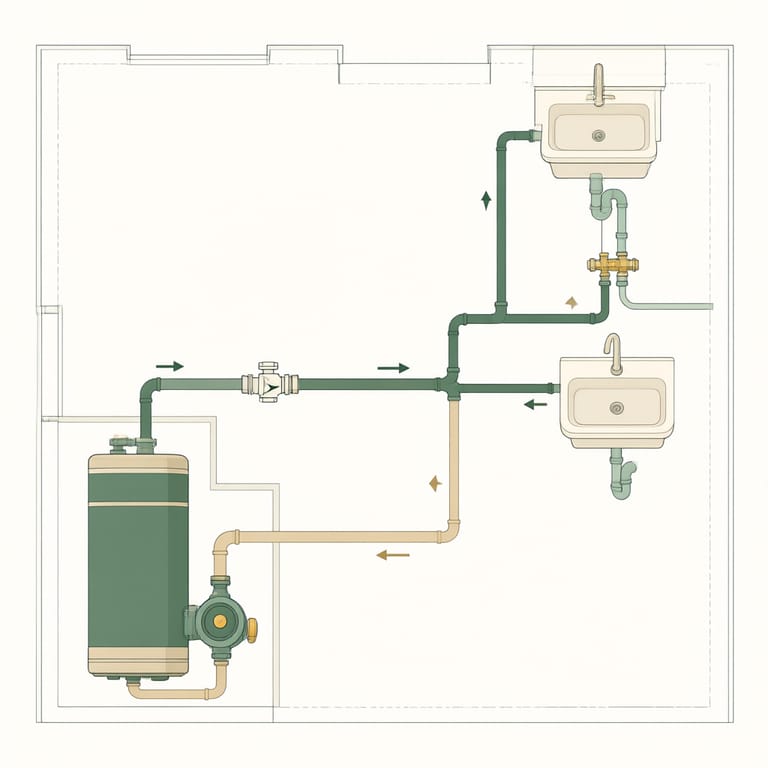
Two safety rules before any diagnosis
Most of these circulators draw power from a wall outlet, so rule one is easy: pull the plug before any screw, union, or cover comes loose. Hardwired unit? Kill it at the breaker and leave the wiring to a licensed pro. Rule two: the pump sits right beside the water heater. If gas odor ever reaches you there, diagnosis ends on the spot: walk everyone out, touching no switch, flame, or phone on the way, and call 911 and then the gas company only once outdoors.
Hot water recirculation pump symptoms: the likely causes, in order
The long wait came back. Power comes first: a pulled cord, a tripped GFCI outlet, or a flat timer battery shows up far more often than a dead motor. Next: the timer follows a schedule your household no longer keeps. Third: the pump has died or seized; see the tests below. Fourth, on crossover systems: the comfort valve failed closed, so cooled flow has nowhere to go and the loop stalls.
The cold tap runs warm, constantly rather than briefly. On a crossover system, a briefly lukewarm cold tap near the far fixture is the design working. Warm cold water all over the house, or hot arriving strongly at the far cold tap, points to a crossover valve stuck open or a failed check valve letting hot migrate, often misdiagnosed as a heater problem.
The pump hums, clicks, or grinds. A hum with no flow suggests a seized rotor or an air-locked casing; grinding, bearings on the way out; rhythmic clicking, a check valve fluttering. Scale is a common root cause in hard-water areas: the mineral load that shortens tank life also gums up small circulators.
Hot water is slower and the energy bill climbed. A failed check valve can let the loop thermosiphon (circulate backward on its own) or let cold water bleed into the hot side, so the heater runs more. If the bill moved and the plumbing did not, suspect the check valve.
Ten minutes of testing before any money moves
- Touch the return line (dedicated loops) near the heater while the circulator should be running: warm means flow; room temperature with a powered motor means a stuck rotor, closed valve, or air lock.
- Listen to the casing. Press a long screwdriver's tip to the pump body and its handle to your ear, the mechanic's stethoscope: on a powered unit, silence says as much as grinding.
- Run the far cold tap for two minutes. Stays lukewarm throughout? Crossover or check valve, not the heater.
- Compare the timer to a real clock. A schedule set last spring may be hours off; one outage or the twice-a-year clock change knocks a plug-in timer out of sync.
What is safe to do yourself, and where to stop
Homeowner territory: everything above, plus resetting timers, swapping a timer battery, and cleaning an inlet screen on models built for it, always unplugged first. Switching the unit off (unplugged, or timer set to off) breaks nothing; the wait simply returns.
Stop at anything that needs a wrench on soldered or threaded loop fittings, any check-valve or comfort-valve replacement, and anything on the water heater side of the connections. The pump costs less than a botched flange gasket's damage, and on gas heaters the work area sits next to combustion equipment: leave the vent pipe alone (a loosened vent connector can spill carbon monoxide into the room), and the gas rule above stands throughout.
Ready to talk to a licensed water heater pro?
Call (800) 555-0184Free call. A licensed local water heater installer picks up.Licensed water heater partners in your area- Licensed and insured partner network
- 24/7 call routing
- Free call, no obligation
- You approve the price with the installer directly
When to call a pro now
- Water at the pump flanges, valves, or any loop joint: small drips at circulators tend to accelerate
- A scalding-hot cold line at multiple fixtures: an active crossover moving real volume
- A breaker or GFCI that keeps tripping when the motor starts: a wiring or winding fault that no timer setting will cure
- Grinding that returns within days of a restart: finished bearings that can seize mid-loop
- Any error code or leak at the water heater itself alongside pump symptoms
A licensed plumber can confirm pump-versus-valve in one visit and usually swap a hot water recirculation pump in the same appointment. Calling (800) 555-0184 puts you through to a licensed, insured installer near you at no charge; scope and price are agreed between you and that pro, not with us.
What water heater pump replacement costs
No national survey we trust prices recirculation circulators alone; the closest published benchmark is Angi's 2026 national range for water heater repair: $228-$1,017, average about $600. A plug-in, flange-mounted circulator swap is a short bolt-on job, so expect the low end of that range unless something below applies. What pushes a quote upward:
- Pump plus control. A timer or on-demand button added to a unit that ran 24/7 raises the part cost once and lowers the energy line after.
- Valve work. A failed check or comfort valve means a second part and a second set of connections, often under a far sink.
- Loop type. Swapping a circulator on an existing dedicated loop is routine; adding a return line where none exists means opening walls or floors.
- Access and shutoffs. Missing isolation valves at the flanges turn a quick swap into a drain-the-system job.
Our labor cost guide shows how plumbing labor is priced by visit and task, so a water heater pump replacement quote reads as line items, not a mystery number.
Two temperatures every loop owner should know
A loop keeps delivery lines hot all the time, so the thermostat setting matters more. CPSC advises a 120°F thermostat setting because of scald risk: 140°F water can give an adult a serious burn in roughly six seconds, and a child burns sooner. OSHA's Legionella guidance, though, says the bacteria survive 120°F storage; its numbers are 140°F in the tank and at least 122°F at delivery. Plumbers square the two by storing hot and tempering down with thermostatic mixing valves that hold what reaches skin near 120°F. That trade-off is a plumber conversation, not a dial experiment.
Questions readers ask about recirculating systems
Does a hot water recirculating pump really work?
On wait time, yes: with the loop warm, a tap that took a minute runs hot in seconds. A pump cannot add capacity or rescue a heater that runs out.
Where a recirculating pump falls short: the disadvantages
Heat bleeding off a loop that runs nonstop, a lukewarm cold tap at the far fixture on crossover systems, an extra motor and valve that can each fail, and mineral scale that shortens the life of both.
Can an existing system take a hot water recirculating pump?
Yes. A crossover kit needs no return pipe: the circulator bolts on at the heater, the comfort valve goes under the most distant sink. A dedicated loop means a return line back to the heater, a far bigger job that usually waits for a remodel.
If it is none of these
A pump only fixes wait time. If the shower runs hot fast but runs out, cools mid-shower, or never gets properly hot, the heater itself is the problem: start with the water heater replacement guide if the tank is past the 8-12 year planning life that Angi and tank manufacturers cite. Pairing recirculation with an on-demand unit? Many tankless models need a recirc-compatible design or a buffer tank; the tankless hub covers the fit.
Ready to talk to a licensed water heater pro?
Call (800) 555-0184Free call. A licensed local water heater installer picks up.Licensed water heater partners in your area- Licensed and insured partner network
- 24/7 call routing
- Free call, no obligation
- You approve the price with the installer directly