
Gas Control Valve Replacement on a Water Heater: Diagnose Before You Pay
Two numbers to know before anyone touches your tank: a thermocouple costs $20-$30, and gas valve replacement on a water heater runs $200-$750 installed (HomeGuide, 2026). Both failures produce the same headline symptom, a pilot that will not stay lit, and the control valve is the priciest part on the tank and easily misdiagnosed. Guess wrong and you pay valve money for a sensor problem.
First, the non-negotiable. If you smell gas (the rotten-egg odor), leave the building immediately, then call 911 and your gas utility from outside or from a neighbor's. Do not flip switches, light flames, or use phones indoors, and never hunt for the leak yourself. The gas leak check guide covers what the utility does when it arrives. Everything below assumes no gas smell. Since replacing the control opens live gas piping, the swap itself is licensed-professional work.
Need a straight answer instead of a parts lottery? Call (800) 555-0184. Embercrest connects you with a licensed, insured local water heater pro; the call is free, and you agree the price directly with the installer.
Gas water heater valve replacement or a $20-$30 thermocouple? Read the symptoms
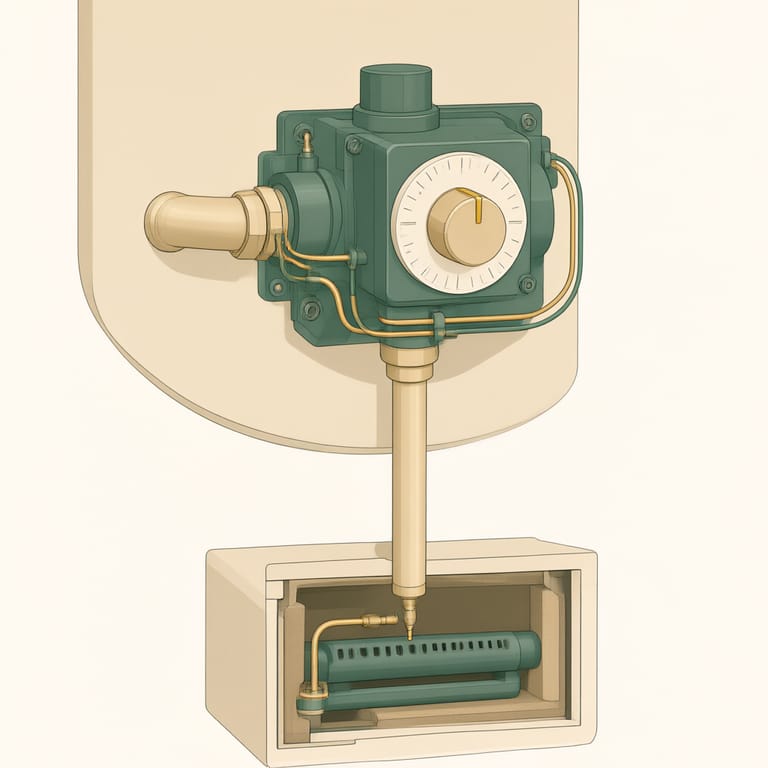
The control valve is the brain of a tank heater: thermostat dial, pressure regulator, pilot safety magnet and, on newer units, a small circuit board with a status light, all in one sealed box on the tank. The thermocouple is the nerve that feeds it. Their failures differ by where the sequence breaks down:
| What you observe | Points to thermocouple | Points to gas valve |
|---|---|---|
| Pilot lights, dies when knob is released | Most likely: weak flame signal | Possible if a new thermocouple did not cure it (worn magnet) |
| Pilot burns steadily, main burner never fires | No; its job is done once the pilot holds | Yes: the control is not opening to the burner |
| Water temperature ignores the dial | No | Yes: the thermostat inside the valve |
| Status light blinking an error pattern | Indirectly (some codes mean a weak pilot signal) | Yes: electronic controls self-report faults |
| Knob spins freely or is stuck | No | Yes: mechanical failure, replace |
| Typical fix cost | $20-$30 part; low end of pro repair range | $200-$750 installed (HomeGuide, 2026) |
Verdict by scenario. Pilot-holding problems: start with thermocouple replacement, the cheap suspect. Temperature or burner-control problems: valve territory. Repeat pilot outages with a fresh thermocouple already installed: valve, and stop feeding parts to a dying control. Recurring outages have a fuller decision tree in why the pilot light keeps going out.
How a pro proves the valve is dead
A competent tech does not guess; these five steps are how you know you hired one:
- History and codes. A blink-code readout from the status light, plus when the failures happen.
- Flame-signal test. A millivolt reading of the thermocouple or thermopile output at the valve terminals while the pilot burns. Strong signal plus a dropped pilot means the magnet cannot hold.
- Supply check. Gas flowing, inlet pressure in the normal range, no kinked or undersized line; a starved control is not a broken control.
- Quote before work. Part plus labor, in writing or by text, before anything comes apart.
- Swap, leak-test, verify. Every fitting touched gets leak solution or an electronic detector, then the pilot is relit, the burner cycled, and the outlet temperature checked.
Gas valve replacement on a water heater: how the swap is actually done
This is not a quick thermocouple-style swap. The control threads into a spud on the tank wall and its thermostat probe sits inside the tank, in the water. So the installer shuts off the gas and the cold supply, drains the tank below the valve through a hose (often the whole tank, since the control sits near the bottom), disconnects the supply line, pilot tube, thermocouple or thermopile lead, and burner manifold tube, and unscrews the old unit. The replacement is model-specific: it must match the fuel (natural gas vs propane), the tank's BTU input, and the pilot assembly it drives, so the part is ordered by model number. The new unit goes in with gas-rated pipe sealant, the tank is refilled and purged of air at a hot tap (never fire a dry tank), then comes the leak test, the relight, and a temperature check.
Water heater gas valve replacement cost: what moves the $200-$750
HomeGuide's 2026 national range for gas control valve work is $200-$750 installed; Angi puts the typical water heater repair visit of any kind at $228-$1,017 (average about $600) for the same year. What moves it:
- The part. Electronic controls for newer sealed-combustion tanks cost more than the plain mechanical valve on an older atmospheric heater; propane versions are a separate part number.
- Warranty status. Inside the manufacturer's parts warranty the control may be free and you pay labor only.
- Drain and refill time. Sediment-heavy tanks drain slowly, and the labor line grows with the visit.
- Access and timing. A tight closet or attic install, or an after-hours or weekend call, pushes toward the top of the range.
Ask for the labor figure and the part price separately before anyone drives over.
Ready to talk to a licensed water heater pro?
Call (800) 555-0184Free call. A licensed local water heater installer picks up.Licensed water heater partners in your area- Licensed and insured partner network
- 24/7 call routing
- Free call, no obligation
- You approve the price with the installer directly
New valve or new heater? Run the 50% rule
Tank water heaters carry an 8-12 year planning life (Angi's 2026 industry figure), and a full tank replacement runs $881-$1,826 typical, averaging about $1,346 installed. A $750 valve job on a ten-year-old tank puts you past half the cost of new equipment on a machine due for retirement: the classic 50%-rule fail. The same job on a four-year-old heater still inside its parts warranty can cost labor only, and repair wins easily.
The Department of Energy's 2029 residential efficiency standards mostly reshape electric models and leave gas storage tanks with minor updates, so no panic-buying, and no over-investing in a dying tank either. The repair hub has the full repair-vs-replace framework.
The new thermostat: set it deliberately
A new control means someone sets the thermostat, so set it on purpose. The CPSC recommends a 120°F thermostat setting: at 140°F, tap water can inflict a third-degree burn in about six seconds, versus roughly five minutes at 120°F (CPSC Publication 5098). The counterweight: OSHA's Legionella guidance notes that 120°F storage does not kill the bacteria, which is why homes with immunocompromised residents often store hotter and temper delivery with thermostatic mixing valves at fixtures. Ask the installer to walk you through the trade-off.
Three objections worth taking seriously
"Seven hundred dollars for a part the size of a paperback?" You are paying a licensed tech to open gas piping, drain and refill the tank, and leak-test the result, not for the box. It is also why the diagnosis step matters: a valve bought on a guess is the most expensive thermocouple you will ever own.
"Will my basement be a mess, and how long without hot water?" The tank drains through a hose to a floor drain or outdoors, so a clean job leaves no puddles; cloudy drain water is normal on an older tank. Expect a few hours of downtime plus recovery time while the tank reheats, longer if the part has to be ordered.
"I could swap it myself for the part price." The control is sold online, and that is exactly the problem: the job opens a live gas connection and ends with a leak test. Most jurisdictions reserve that work for licensed plumbers or gas fitters, for good reason.
Red flags: call instead of tinkering
- The pilot will not hold even after a new, correctly seated thermocouple.
- The pilot burns but the main burner never fires, or water temperature ignores the dial.
- The status light repeats the same error code after a reset.
- Yellow, sooty, or roaring flames, or scorch marks around the burner door (incomplete combustion and a carbon monoxide risk).
- Any smell of gas at any point: out of the house first, then 911 and the gas utility from outside.
Want gas valve replacement on a water heater priced by someone who tests before quoting? Call (800) 555-0184. Embercrest connects you with a licensed, insured local pro; ask for thermocouple, supply, and control checked in one visit, and a quote on both the repair and the new-tank path.