
How to Check for a Gas Leak in a Water Heater (and When Not To)
A strong gas smell, or an audible hiss, ends the reading here. Get everyone out at once and touch nothing on the way: no light switches, no lighters, no phone use until you are outdoors. From the yard or a neighbor's porch, dial 911 first, then the gas company's emergency line. Going back in to find or tighten anything yourself is not an option.
No checklist outranks that rule. Everything below covers the other situation: a faint, come-and-go rotten-egg whiff near the tank, worth verifying before you escalate. Here is how to check a water heater for a gas leak the way a technician would (tank or tankless, what many homeowners call the hot water heater), where DIY stops, which signs mean call now, and what the fix costs.
Why your nose finds a leak first
The rotten-egg note is not the gas itself. Raw natural gas would slip past your nose, so utilities blend in a sulfurous odorant that makes any leak give itself away. About 48% of US households heat water with natural gas, per the US Energy Information Administration, and on each of those tanks the handful of threaded connections (shutoff valve, flex connector or union, control valve inlet, pilot tube) is where a leak almost always lives.
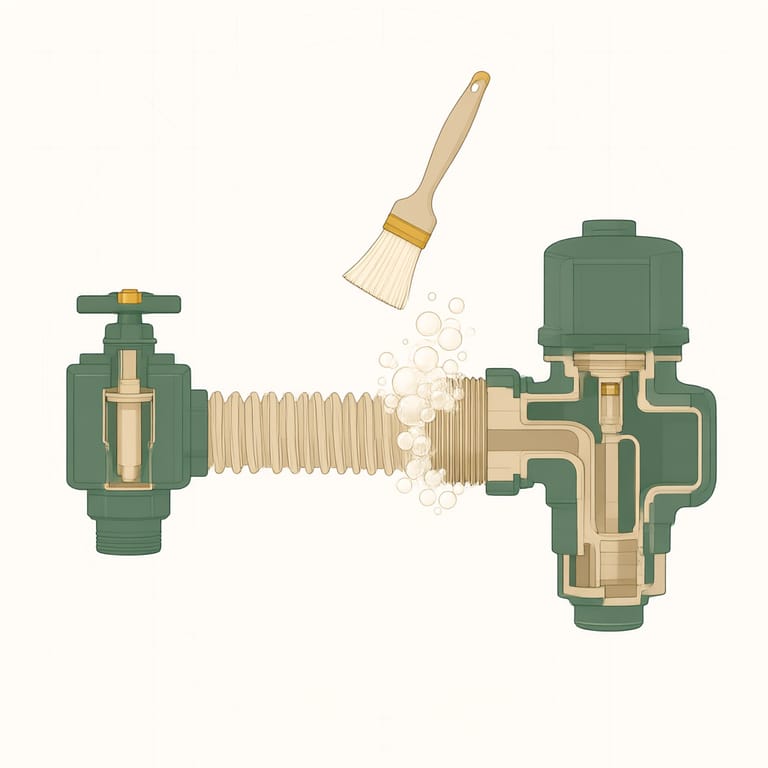
What a faint whiff near the heater can be
In rough order of likelihood:
- A pilot that just went out. The thermocouple closes the valve within moments, but the brief unburned flow leaves a short-lived odor. If the pilot is out and the smell fades within minutes, relight per the label once the odor has cleared. Relights needed again within days are a parts problem; the pilot light guide ranks the causes.
- A fitting seeping at trace levels. Threads never leak-tested after a tank swap, a flex connector kinked during installation, or a union loosened by years of heating and cooling. This is the case the soap-bubble test is built for.
- Something that is not the heater. Sewer gas from a dried-out floor-drain trap fools people regularly, and floor drains sit next to water heaters in many basements. A dead rodent or a seeping furnace or dryer connection on the same line gets blamed on the tank too.
How to tell which it is
Timing and location separate the three. A smell that appeared right after the burner went cold and is gone in ten minutes points at the pilot. One that sits at nose height by the fittings and never fully clears points at a seep. One strongest at floor level near a drain points at the trap: pour a quart of water down the drain and see whether the odor is gone by tomorrow. A plug-in natural gas detector removes the guesswork, and since odorant can fade, one near the heater earns its place.
How to check for a gas leak in a water heater: the soap-bubble test
Proceed only while the odor stays faint and the room is ventilated; if it strengthens mid-test, switch to the protocol at the top.
- Stir a squirt of dish soap into a cup of water, or pick up leak-detector fluid in the hardware aisle.
- Paint it thickly over each joint: the shutoff valve, both ends of the flex connector or the pipe union, the inlet fitting at the control valve, and the small pilot tube fitting beside it. On a tankless unit, brush the shutoff valve and inlet union.
- Give it half a minute. Escaping gas inflates the film, so you want bubbles that keep growing, not the static foam you painted on.
- A flame is not a test tool, ever. The old match trick is how a leak check turns into a house fire.
No bubbles and no returning odor? Keep an occasional nose on it. Bubbles that grow, or a smell that keeps coming back: next section.
Ready to talk to a licensed water heater pro?
Call (800) 555-0184Free call. A licensed local water heater installer picks up.Licensed water heater partners in your area- Licensed and insured partner network
- 24/7 call routing
- Free call, no obligation
- You approve the price with the installer directly
Where DIY stops
Once a joint bubbles, the homeowner's job is containment, not repair. Rotate the heater's shutoff valve ninety degrees so the handle runs across the pipe (that isolates the appliance), crack a window, step out, and make two calls: the gas utility (their emergency line exists for exactly this) and a licensed pro for the fix.
What you do not do is re-tape threads, swap the flex connector, or crank a fitting another quarter turn on a live line. Gas piping is code-regulated, licensed-trade work across most of the US, and a wrongly torqued fitting leaks worse than the one you started with. The same rule covers the control valve, the venting, and the T&P valve: licensed pro only.
Red flags: call now, not later
- Bubbles growing at any fitting, even slowly.
- An odor that builds, drifts into other rooms, or comes back after a pilot relight.
- An audible hiss at the tank or its piping.
- Anyone in the house feeling dizzy, nauseated, or headachy while the odor lingers: get out first, make the calls second.
- Soot, scorch marks, or a lazy yellow burner flame: a combustion fault with carbon monoxide risk rather than a leak, and still a same-day call.
The utility's technician sweeps the room and the heater with a combustible-gas meter, shuts off and red-tags the appliance if it leaks, and leaves the repair to a licensed contractor. Call (800) 555-0184 and Embercrest connects you with a licensed, insured local water heater pro; partner installers answer 24/7, the call is free, and you approve the scope and price with them directly.
What the repair costs
By HomeGuide's 2026 national figures, gas control valve work and complex leak repairs on a water heater run $200-$750. A seeping flex connector or a re-made union sits at the low end, a failing control valve at the high end, and the gas control valve replacement page shows how a pro proves the valve is dead before you pay for one.
Before approving the expensive version: storage tanks carry an industry planning life of 8-12 years (Angi), and on a tank near the end of that window a repair at the top of that $200-$750 range rarely beats putting the money toward a new gas water heater, which Angi prices at $881-$1,826 installed for 2026.
After the all-clear
Once the fitting is fixed and leak-tested, relight the pilot per the label (the pilot walkthrough covers the sequence). A CO alarm near the utility room is cheap insurance on any fuel-burning tank, and if your utility offers a free gas-appliance inspection, a heater that has misbehaved is the right candidate.
Other symptoms, from rumbling to lukewarm water, live in the repair library. Want a pro's eyes on the fittings today? (800) 555-0184 connects you with a licensed, insured local installer, free, with the price agreed between you and the pro.