
Water Heater Thermocouple Replacement: The Small Part Behind a Dying Pilot Light
The pilot catches while your thumb holds the knob, then vanishes the second you lift it. Recognize that routine? The water heater itself is likely fine. The culprit is a tired thermocouple, a $20-$30 part (HomeGuide, 2026) whose only job is telling the gas valve a flame exists. Water heater thermocouple replacement is one of the cheapest fixes in the trade; this page covers how to confirm the diagnosis, what it costs with and without a pro, and when the money belongs in a new tank instead.
Two rules sit above everything else here. If the room carries that sulfur, rotten-egg odor, gas is leaking: walk everyone out of the house, and only then dial 911 and your gas utility, from the yard or a neighbor's porch. Do not flip a switch, strike a lighter, or pick up a phone while you are still indoors. Nothing described below opens a gas line; the moment a repair would, it becomes a job for a licensed pro.
Need it handled today? Call (800) 555-0184. Embercrest connects you with licensed, insured local water heater pros; the call is free, and you approve price and scope with the installer.
What the sensor does, and why it is suspect number one
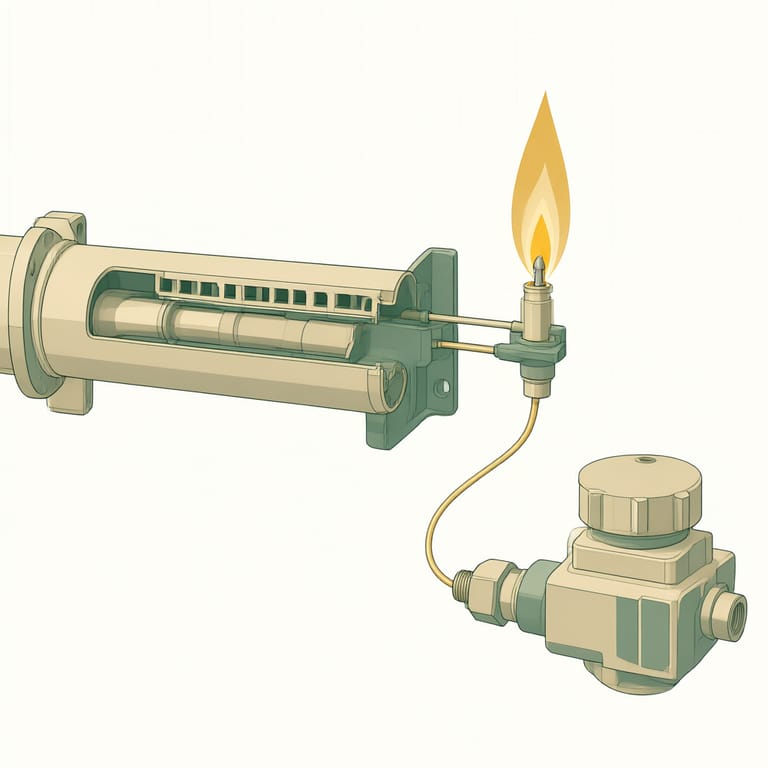
A thermocouple is nothing more than a flame detector: a pair of unlike metals fused at the tip. Parked in the pilot flame, that junction produces a tiny voltage, just enough to keep the electromagnet inside the gas valve pulled in. Take away the flame and the voltage fades, the magnet releases, the valve snaps shut, and unburned gas never reaches the room. Natural gas heats the water in roughly 48% of US homes, according to the US Energy Information Administration, which is why this modest sensor quits in so many basements. Thousands of heat-up and cool-down cycles slowly oxidize the tip until its output drops below what the magnet needs.
Three checks before you buy anything
- Hold-and-release. Light the pilot, keep the knob pressed for the interval printed on the tank label, then let go. Out instantly? That is the thermocouple's signature.
- Read the flame. A good pilot is a steady blue cone that envelops the sensor tip. One that is feeble, yellowish, or dancing off to the side of the sensor points to a clogged pilot orifice more often than not; clearing it frequently cures what looked like a dead sensor. Lazy yellow flames or soot deposits on the burner door mean the gas is not burning cleanly, which brings carbon monoxide into the picture: stop there and get a pro in.
- Check the wind. Pilot dies on gusty days or when the furnace kicks on? That is a draft or venting problem wearing a thermocouple costume; new parts will not cure it, and venting is a licensed-pro job.
If a new, correctly seated thermocouple still will not hold, the gas control valve's magnet may be the real casualty; see gas control valve replacement for how that diagnosis differs. A pilot that keeps quitting has several possible causes; our guide to a water heater pilot light that keeps going out walks through them, so read it before money changes hands on parts.
Water heater thermocouple replacement: how the job is done
On an ordinary atmospheric-vent gas water heater the thermocouple lead travels from a clip next to the pilot tube back to a small threaded fitting on the bottom of the gas control valve. The swap in one breath: turn the gas knob to OFF, pull the burner access cover, back the fitting off the valve, unclip the worn sensor from the pilot bracket, seat the new one so its tip rides in the hottest part of the pilot flame, tighten the fitting only as far as the leaflet in the box says (hand-tight plus a small fraction, never wrenched hard), then relight by the label on the tank and watch that the pilot keeps burning once your thumb comes off the knob. That fitting carries an electrical signal and sits outside the gas path, so no gas piping is disturbed.
Two complications. Newer sealed-combustion models (FVIR, short for flammable vapor ignition resistant) tuck the burner behind a gasketed door and frequently use a one-piece pilot assembly or a thermopile, the heavier-duty cousin of a thermocouple; manufacturers want a trained installer in there. And the part has to match: universal thermocouples fit most older units, while newer models often demand a brand-specific assembly.
From your side, a pro visit has five beats: confirm the diagnosis rather than swap and hope, quote part and labor before touching anything, replace the sensor or assembly, relight and verify the flame signal holds, then check every fitting that was touched for leaks.
What the fix costs: part vs. pro visit
| Route | Typical outlay | What you're paying for |
|---|---|---|
| Part only (universal thermocouple) | $20-$30 | HomeGuide 2026 part pricing; add basic wrenches if you own none |
| Pro repair visit | Low end of $228-$1,017 | Angi's 2026 national water heater repair range (average about $600); single-part burner work sits near the bottom, diagnosis included |
| Worst case nationally | Up to $1,775+ | Top of the HomeGuide/Angi 2026 spread ($90-$1,775+); usually means the thermocouple was not the real problem |
What moves the price: sealed burner doors that need gaskets and torque care, pilot assemblies sold only as complete OEM units, gas control valve trouble found during the visit (HomeGuide puts valve work at $200-$750 for 2026), and after-hours timing. Ask for the labor figure on the phone before anyone drives over. More in our water heater repair cost guide.
Ready to talk to a licensed water heater pro?
Call (800) 555-0184Free call. A licensed local water heater installer picks up.Licensed water heater partners in your area- Licensed and insured partner network
- 24/7 call routing
- Free call, no obligation
- You approve the price with the installer directly
Doing it yourself: the honest version
Water heater thermocouple replacement is one of the few gas-appliance repairs a careful homeowner can reasonably tackle, precisely because no gas line gets opened. The catches:
- Access. Older atmospheric heaters: the burner assembly slides out. Newer FVIR heaters: sealed chamber, gasketed door, and a pro belongs in there.
- Torque. The nut at the gas valve needs only a gentle snug past hand-tight. Over-tighten it, crack the seat, and a $20-$30 part has cost you a gas valve.
- Placement. The tip must sit in the pilot flame's hottest zone. Miss that zone and you will chase "failed" parts for weeks.
Repair it, or retire the heater?
A thermocouple failure on a heater only a few years old is a no-brainer repair. The same failure on a tank past the 8-12 year planning life the industry uses (Angi, 2026), with rust streaks at the fittings, moisture in the pan, or rumbling sediment, is your heater asking for retirement. Our working threshold: once a repair estimate climbs toward half of what a new standard tank costs installed ($881-$1,826, Angi 2026), the smarter spend is the new unit. The repair hub walks through which symptoms tip that scale.
Three doubts, three straight answers
"A service call for a $20-$30 part?" The call buys a correct diagnosis: the same symptom can be a dirty pilot orifice, a draft, or a dying gas valve, and a pro checks all three in one visit.
"How long am I without hot water?" The swap takes minutes, the pilot is relit before the installer leaves, and the tank starts reheating right away. Nothing is drained and no mess is left behind.
"I could just do it myself." On an older open-burner heater, maybe. On a sealed FVIR unit, or if anything about gas makes you hesitate, the honest answer is no, and the price gap is small.
Put the wrench down and call when
- The pilot refuses to light at all, new sensor or not.
- The pilot stays lit on its own, yet the main burner refuses to kick in; that points at the gas valve or the thermostat, not the sensor.
- Flames that are yellow, sooty, or roaring, or scorch marks around the burner door.
- A wet floor or rust at the tank seams: at that point the conversation is about a new heater.
- Gas odor at any moment: everyone outside first, phone second.
For water heater thermocouple replacement, or a side-by-side quote on a new tank, call (800) 555-0184. Embercrest connects you with a licensed local pro who prices the fix and the new tank together, and you pick.