
Water Heater Expansion Tank Replacement: Why the Relief Valve Keeps Tattling
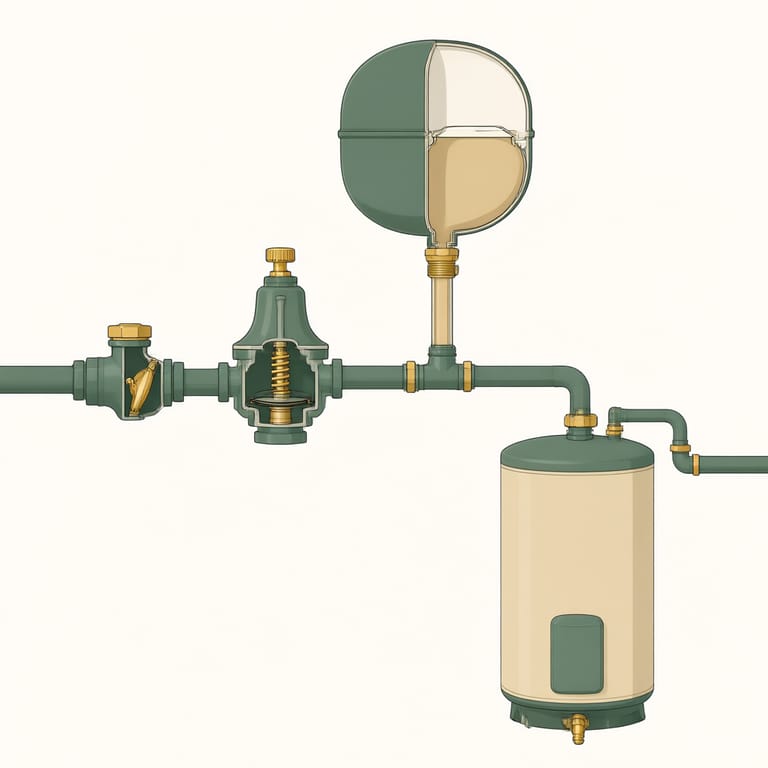
Heat a tankful of water and it takes up more room than it did cold, and your plumbing has no say in the matter. Where the meter side carries a check valve, backflow preventer, or pressure-reducing valve, the house piping is a closed loop: each heating cycle crams the surplus volume against shut faucets and closed valves. An expansion tank gives that surplus somewhere to go, so the pipes never have to carry the strain. Once its bladder fails, a pressure spike has a single exit left, the relief valve on the heater. ICC's water heater safety guidance lists thermal expansion among the reasons a T&P valve discharges; the valve is doing its job and telling on the failed part next door.
If a dripping relief valve is what sent you here, start with the T&P valve page for the safety angle. What comes out of that discharge pipe can be nearly as hot as the tank (CPSC scald tables put a third-degree burn at about six seconds in 140F water), so nobody's hands, and no children, should be anywhere near it. Swapping the relief valve without curing the expansion problem only books the next drip.
Want it diagnosed, not guessed at? Call (800) 555-0184. Embercrest connects you with a licensed, insured local installer who can check pressure, valve, and expansion tank in one visit. The call is free; you approve price and scope directly with the installer.
What a thermal expansion tank does, and why it dies quietly
The thermal expansion tank itself is a squat steel canister threaded into the cold line a short run from the heater. A flexible rubber bladder divides the inside, water on one face and a charge of compressed air on the other. As the heater brings a tankful up to temperature, the extra volume pushes across into the canister and squeezes that air, and the pipes, fittings, and T&P seat never feel it. The air side ships at a generic factory setting and is supposed to be adjusted to the static pressure your house actually runs, at install time.
Failure is silent and comes in two flavors. In the first, the bladder splits, water floods the air chamber, and the canister turns into dead weight that cushions nothing. In the second, air seeps out past the Schrader valve over months, and a unit that is mechanically fine quietly stops working. Neither announces itself at the canister. The clues turn up elsewhere: a cup or two from the relief valve after showers or laundry, a faucet that spits hard when first opened, a gauge that swings far above street pressure once the heater has run.
Is the expansion tank bad? Two quick tests, no tools needed
| Check | Healthy | Failed |
|---|---|---|
| Knock top and bottom | Top rings hollow, bottom sounds solid | Dull thud everywhere: waterlogged |
| Press the air valve on top briefly | Air hisses out | Water spits out: bladder ruptured |
| Look at the shell and connection | Dry, paint intact | Rust streaks, weeping at the threads, unit sagging on the pipe |
| Watch the T&P valve after hot-water use | Dry | Short discharges after showers or laundry |
A unit that fails the knock test but passes the air-valve test may only have lost its air charge, sometimes recoverable with a tire gauge and a hand pump. Water at the air valve is terminal, no exceptions. A corroded or leaking shell is its own small emergency: a burst expansion tank floods like any other plumbing failure, and the triage steps in water heater leaking apply.
How the swap is done, step by step
Ground rules before the wrench comes out. The relief valve itself, anything on the gas side, and 240-volt wiring belong to a licensed pro. Whatever bleeds from a hot tap during the job can be as hot as the tank, so keep fingers and children well back. Catch a whiff of gas at any stage and the job stops: walk everyone out of the house without touching a light switch, striking a flame, or using a phone indoors, and dial 911 and the gas utility once you are outside.
- Pressure first. The installer threads a gauge onto a hose bib and reads the house's static water pressure, ideally twice: cold, and again right after the heater has run. Chronic high pressure kills bladders young, and no expansion tank fixes a pressure problem; a pressure-reducing valve on its way out gets flagged at this step, not after the next drip.
- Sizing and precharge. Sizing follows the heater's gallon rating, and the air charge is pumped to the pressure just measured before the unit ever touches the pipe. Charged wrong, it is a decoy.
- The swap itself. Power down: gas control to OFF, or the breaker for an electric heater, then the cold inlet closed and a hot faucet cracked to let pressure out. The old canister unthreads from its tee, the threads get a clean and fresh sealant, the replacement spins on, and the line is refilled while an upstairs tap vents the trapped air.
- Support and verification. A working unit takes on water with every cycle and gets heavy, so a careful install straps or brackets it instead of letting a threaded fitting carry the load. Then the T&P valve is watched through one full heating cycle. The drip that brought you here should be gone.
Ready to talk to a licensed water heater pro?
Call (800) 555-0184Free call. A licensed local water heater installer picks up.Licensed water heater partners in your area- Licensed and insured partner network
- 24/7 call routing
- Free call, no obligation
- You approve the price with the installer directly
Water heater expansion tank replacement cost in 2026
Nationally, water heater repairs run $228-$1,017 with an average near $600 (Angi, 2026), and the cost of a hot water heater expansion tank replacement sits at the friendly end of that band: a small part, light labor, and a like-for-like connection. What moves the price:
- First-time install versus like-for-like swap. A home that never had expansion control needs a tee, possibly a shutoff, and a bracket added: more labor than spinning a new unit onto an existing fitting.
- The real culprit. If the visit uncovers a failing pressure-reducing valve or street pressure out of spec, that repair is separate and usually bigger than the swap.
- Access and support. Attic heaters, tight closets, and overhead mounting that needs a strap kit add time.
- Paperwork. Some jurisdictions fold expansion control into the water heater permit, and an unpermitted install can surface at a home-sale inspection. The permit guide covers who pulls what and when it matters.
Recharge it, replace it, or replace the heater?
Recharge. Knock test fails, air-valve test passes (air, not water). Set the precharge to measured house pressure and recheck in a week. If the drip returns, the bladder is porous and you are at the next step.
Replace the expansion tank. Water at the air valve, rust at the shell, or a recharge that does not hold. This is the common case.
Fold it into a heater replacement. If the heater is at or past its 8-12 year planning life (Angi, 2026) and the relief valve, anode, or tank body is also showing age, a new expansion tank is usually a line item in the replacement quote rather than a separate visit. Angi's 2026 installation data puts tank-style replacement at $881-$1,826 installed, with the expansion tank among the add-ons on top. A standalone swap in year eleven, then another with the new heater in year twelve, is the outcome to avoid.
Three honest objections: cost, mess, and DIY
Cost. It is a small job, and some plumbers bundle it with other work to make the trip worthwhile; ask when booking whether a flush can ride along.
Mess and downtime. Minimal. No wall is opened, nothing is drained beyond a cup or two, and hot water is back as soon as the system is refilled, usually the same visit.
The DIY temptation. The swap is wrench work on a threaded fitting, no gas and no 240-volt wiring, and many handy homeowners do it. The two silent failure points are the ones the test table cannot show: installing with factory precharge (the unit then does nothing and the drip continues), and hanging a future water-filled weight off unsupported pipe. Set the precharge to measured house pressure, support the vessel, and DIY is defensible. The T&P valve itself stays with a licensed pro.
When to stop guessing and call
- The drip returns within days of a correct swap: persistent overpressure has a short list of causes, and a pro with a gauge narrows it down fast.
- Static pressure reads high on a gauge, or swings widely after a heating cycle.
- The shell is weeping, rusted, or sagging on its fitting.
- The house never had expansion control and has a check valve or PRV at the meter.
Start at the repair hub for the broader decision tree, or call (800) 555-0184: Embercrest connects you with a licensed, insured local installer for a straight quote on water heater expansion tank replacement. Ask for the pressure check as part of the visit.