
Water Heater Anode Rod Replacement Cost: a $20-$50 Part Guarding a $1,346 Tank
The anode rod is the only part in your water heater whose entire job is to be destroyed. It corrodes so the steel tank holding your hot water does not, and once it is gone the tank starts eating itself with no second line of defense. That makes the water heater anode rod replacement cost the strangest line item in plumbing: a $20-$50 metal stick whose replacement schedule goes a long way toward deciding whether your tank dies at year 8 or year 12. Here is the 2026 number, what moves it, and when it stops being worth paying.
Water heater anode rod replacement cost in 2026
The table is an Embercrest compilation of 2026 national cost data from Angi and HomeGuide, checked August 2026. Installed figures include the part, labor, and the visit; the anode replacement cost you are quoted for your water heater should land inside the first row.
| Line item | 2026 price | Context |
|---|---|---|
| Professional swap, installed | $150-$350 | Part, labor, and the visit |
| The rod itself | $20-$50 | Magnesium or aluminum, hardware-store item |
| Tank flush on the same visit | $100-$350 (the flush itself) | HomeGuide small-fix tier; same drained tank, one trip charge |
| The tank you are protecting | $881-$1,826 installed | Typical replacement; national average about $1,346 |
| Heat pump unit (the replacement path for electric tanks over 35 gal after May 2029) | $3,200-$4,700 installed | Typical 2026 range per Angi |
Rather have it done on the next maintenance visit? Dial (800) 555-0184: the call is free, it reaches a licensed, insured local installer in Embercrest's partner network, and the price is a matter between you and that installer.
Why the ugliest part in the tank is the best money
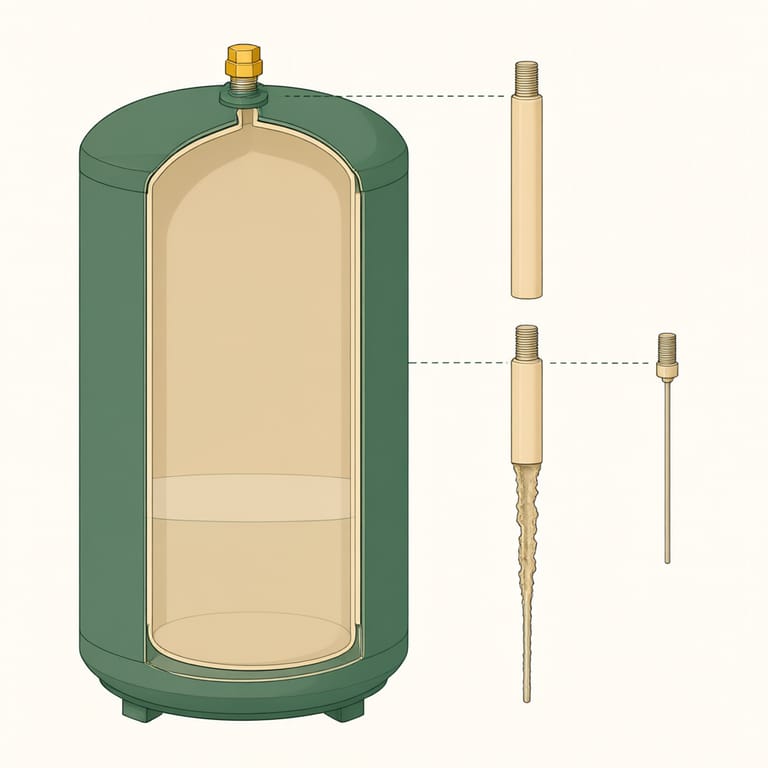
A steel tank holds hot water full of dissolved oxygen and minerals, precisely the mixture that rusts steel. The sacrificial anode exploits a quirk of chemistry: magnesium and aluminum surrender electrons more willingly than iron, so the rod rusts away in the tank's place. While the anode has metal left, the shell hardly ages; once it is spent, every nick in the glass lining turns into a live rust site.
Now the arithmetic. Two replacements over a tank's life cost $300-$700 at the professional rates above. The tank replacement it postpones averages about $1,346 (Angi, 2026). The maintenance pays for itself if it buys the tank a few extra years, and the planning figures say it can: industry sources (Angi and manufacturer guidance) put storage tanks at 8-12 years, while the Department of Energy's Energy Saver guidance credits maintained conventional tanks with roughly 10-15. Anode service and periodic flushing are the maintenance in question. The full anode rod service guide covers the how; this page's job is to justify the price.
What moves the bill inside $150-$350
- A seized hex head (up). Years of heat cycles can fuse the fitting to the tank with corrosion. Freeing it takes an impact wrench and patience, and some pros bill for the fight.
- Overhead clearance (up, or a workaround). A one-piece rod has to slide straight out the top, so a low ceiling forces a segmented (linked) rod: slightly pricier, slightly more awkward to thread in.
- The service-call minimum (up on a standalone visit). A bare swap is a short job, so a trip charge can be a large share of a small invoice.
- Bundling (down). The tank has to be partly drained for either job, so pairing the swap with a water heater flush gets two maintenance tasks out of one trip charge.
- Water chemistry (frequency, not price). Softened water eats anodes faster, a known side effect of salt-based softeners. Same bill, sooner.
Hidden costs, and the ones you get to skip
The extras list is short.
- Permits: ask, but do not expect one. A like-for-like anode swap counts as maintenance, not installation. A whole-tank swap is a different story, covered in our water heater permits guide.
- Disposal: none worth pricing. The spent anode is a few pounds of scrap metal.
- Parts found along the way (priced separately). Emptying the tank works a drain valve that may not have moved in years, and the T&P relief valve (temperature and pressure) often gets disturbed too. A drain valve that will not close tight afterward, or a relief valve that keeps dripping, is its own repair (licensed-pro work), not an anode upcharge; ask for it as a line item.
- After-hours rates: avoidable. Nothing about this job is urgent on the day. Book a weekday visit and the after-hours multiplier never applies.
Magnesium, aluminum, or powered
Every standard option falls inside that $20-$50 part price, yet the metal matters more than most homeowners are told. Magnesium gives the strongest protection and is the usual pick for ordinary water; it also gets used up fastest. Aluminum (aluminum-zinc) lasts longer and copes better with hard water; the zinc blend is the standard fix for sulfur-smelling hot water, since that odor is typically bacteria reacting with a magnesium rod. Powered (impressed-current) anodes swap chemistry for electronics: a small current does the protecting, nothing gets consumed, nothing needs re-replacing. They cost meaningfully more up front and pay off in softened water, where sacrificial rods vanish fastest.
GE water heater anode rod replacement: the brand does not change the part
Owners of GE-branded tanks often go looking for a GE-specific part. An anode rod is matched by thread size, length, and head style (hex or combo), not by tank brand: take those three from the rating plate and manual, and any quality replacement anode rod for a GE water heater will fit. National pricing data carries no brand line either; an installer quotes an anode swap, $150-$350 installed, whatever the label says.
Ready to talk to a licensed water heater pro?
Call (800) 555-0184Free call. A licensed local water heater installer picks up.Licensed water heater partners in your area- Licensed and insured partner network
- 24/7 call routing
- Free call, no obligation
- You approve the price with the installer directly
How often you pay it, and how to check without paying for a swap
The published interval for checking an anode is every 3-5 years, leaning toward 3 in softened or aggressive water. The practical version: have it pulled on the same visit as a flush, and replace it once more core wire than metal is showing.
Once the tank is drained anyway, looking costs nothing, and a pulled rod tells its story at a glance: healthy is a rough but unbroken cylinder of gray metal; spent is a thin steel wire with a few lumps clinging to it, like a chewed pencil. Thick calcium crust, pits that reach the wire, or a rod that breaks apart on the way out all say the tank has gone unprotected for a while. With more than half the sacrificial metal gone, replace it on that same visit rather than pay for a second drain-down later; the part never costs less than while the tank is open.
Why quotes vary from one ZIP code to the next
The table is national, and the spread inside it is mostly labor. The part costs the same in every state; what changes is the hourly rate and trip charge of whoever drains the tank, and older housing stock means older tanks with fittings that fight back. Get two quotes, ask whether a flush is included, and compare the installed figure against the $150-$350 band above, not a neighbor's number.
The 2029 wrinkle: stretching an electric tank just got more valuable
One reason to take this maintenance seriously is new. Starting May 6, 2029, under the finalized efficiency standards from the Department of Energy, a new electric storage water heater larger than 35 gallons has to be a heat pump model. Heat pump units install at $3,200-$4,700 typical (Angi, 2026) versus $881-$1,826 for today's standard tanks. If you own a healthy electric resistance tank, every year of life you buy it with a $150-$350 anode swap is a year you push back a much bigger replacement decision. Few maintenance jobs become more valuable because of a federal rule; this one just did.
DIY: honest assessment
Safety first: kill power at the breaker (gas unit: control to pilot) and give the tank time to cool before any water leaves it. On a gas unit, pilot is as far as this job goes: the vent pipe on top stays untouched (a displaced vent can dump carbon monoxide into the house), and anything touching the gas valve or venting is licensed-pro work. Smell gas at any stage and the job ends there: everyone leaves the building at once, nobody touches a switch, strikes a flame, or makes a call while still inside, and the two calls, 911 first and then the gas utility, happen from outside. The water you would be draining is tank-temperature: at a typical 120F setting, roughly 5 minutes of contact means a serious burn, and plenty of tanks run hotter, where the CPSC's scald data counts third-degree burn times in seconds (around 30 at 130F, around 6 at 140F).
With that handled, the idea itself is short: let out a few gallons, back out the old anode, thread in the new one. Reality adds two wrinkles: the factory-torqued fitting often laughs at hand tools (plan on a breaker bar or impact driver plus a way to keep the tank from rotating), and ceiling height settles the straight-versus-segmented question before you shop. The realistic DIY saving is the labor share of the $150-$350; the part is $20-$50 no matter who buys it.
Call a pro instead if any of these apply:
- the hex head refuses to budge under reasonable force;
- nothing has touched the fitting in 10+ years (assume it is seized and the old metal crumbled);
- hot taps smell of rotten eggs (anode chemistry and bacteria get diagnosed together);
- the tank shows rust streaks at the seams, at which point you have left maintenance territory entirely.
When to skip the rod and spend the money elsewhere
An anode rod buys time for a tank with time worth buying. It cannot revive one that is already finished: a shell weeping from the body, rusty water that a fresh anode and a flush fail to clear, or a unit past its 12th year is a replacement candidate, and $350 of maintenance becomes a tip on a bill you are paying anyway. Run the decision through our repair vs replace guide before booking either job.
Anode rod pricing, the short answers
What does it cost to have the anode rod in a water heater replaced?
Budget $150-$350 installed by a pro in 2026 (HomeGuide and Angi data); the rod on its own is $20-$50 at retail. A flush sits in HomeGuide's $100-$350 small-fix tier, and booking both for one visit means one trip charge, not two.
Does a water softener raise the water heater anode rod replacement cost?
Not per visit; it shortens the interval. Softened water uses up a standard anode faster, so plan on the 3-year end of the 3-5 year window, or buy a powered anode once and stop replacing.
Does the price differ between gas and electric tanks?
No. The part and the swap are identical; only the shutdown step differs (control to pilot on gas, breaker off on electric).
For a straight answer on your tank (rod, flush, or a frank "start budgeting"), call (800) 555-0184. Embercrest is an independent publisher; the number rings through to licensed, insured local installers in our partner network, and nothing is billed without your approval. All of our pricing research lives at the cost hub.
Ready to talk to a licensed water heater pro?
Call (800) 555-0184Free call. A licensed local water heater installer picks up.Licensed water heater partners in your area- Licensed and insured partner network
- 24/7 call routing
- Free call, no obligation
- You approve the price with the installer directly